Space (for miracles)

I can’t say much about Mothers’ Day. It would all be speculation, guess work. I can just imagine that there is so much pain and so much joy there all at the same time. For all sorts of different reasons.

sky-1122413_960_720

There was no smell of toast, coffee, and a (very burnt) fry coming out of the kitchen today in our house. Just the memory of it. The thing is that not just us but also our children are getting older.

Pádraig had a relaxed day today. Late breakfast. Late lunch. A walk in the park. In between banana milk, a spoon full of honey (for good health), steak, potatoes and broccoli. No strenuous exercises, no tilt table, not MOTOMed.

“There are miracles waiting to happen” is a saying I like.

While talking to someone in LA today who is rapidly becoming a good friend, we realised that miracles, extraordinary things, need space and opportunity to happen and to make a difference. This is what what I am looking for and will build, with the help of our friends, for Pádraig and other persons like him. An Saol will provide space and opportunity for brains to re-learn guided by the best ‘teachers’.

Montana

Madrid is full of boys named Paco, which is the diminutive of the name Francisco, and there is a Madrid joke about a father who came to Madrid and inserted an advertisement in the personal columns of El Liberal which said: PACO MEET ME AT HOTEL MONTANA NOON TUESDAY ALL IS FORGIVEN PAPA and how a squadron of Guardia Civil had to be called out to disperse the eight hundred young men who answered the advertisement.

This is the beginning of Hemingway’s short story , The Capital of the World.

sfx_300_logo_small_colour

The priest at tonight’s Novena in Gardiner Street Church told this story when he was interpreting the story of the prodigal son in St. Luke’s gospel. I suppose the idea is that we are all Pacos. We all have done something wrong in our lives and we all want our father to forgive us.

I was trying to calculate when I first went to the Novena in Gardiner Street. I think it was in 1987. It was 29 years ago. With Pat and her sister. Then, when our children were born, we brought them along. It was always so packed that there were people working in the Church telling us where we could stand.

There is a Novena of Grace prayer that is said each of the nine days, and it contains the lines:

I also ask you to obtain the favour I ask in this novena.
(Here pause to ask the favour you seek.)
But if what I ask is not for the greater glory of God, or the good of my soul,
obtain for me what is most conducive to both. Amen.

Each year I went, I prayed for the people in our family who needed it most, I thought. Never in my wildest dreams had I ever thought that one day, we would be bringing in Pádraig, in a wheelchair, and be praying for him.

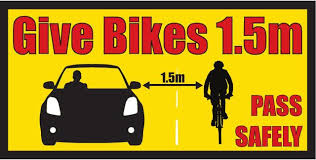
1.5m

Give bikes 1.5m.

Because this is a safe distance to pass a bicycle.

images2Give An Saol 1.5m.

Because this is the amount (by pure co-incidence) that we need to start a 3-year pilot project demonstrating how advances in neuro rehabilitation research can inform neurological rehabilitation leading to a successful recovery following severe Acquired Brain Injury (sABI).

(Anyone out there who could take this idea and design a brilliant campaign logo?)

I have shared the (draft) plan for the project with some experts, abroad and in Ireland, and with you here on the blog. I have also shared them with the HSE.

We’ll finalise the plan over the next week and launch the project in May.

In preparation of the launch, we will raise awareness with survivors and their families, politicians, practitioners, researchers, the administration, and voluntary organisations.

Teach An Saol – Life and Living with a severe Acquired Brain Injury (sABI) will become a reality. It will bring long-term neuro rehabilitation to people who take a long time to recover.

And we will raise the funding necessary to bring life and dignity to young people one way or the other. There is no alternative.

Pádraig continues to cycle the MOTOMed by himself. He’s half an hour on the tilt table every day. (To the best of my knowledge, the famous standing bed, while approved several times, has still not even been ordered.)

He and others in his position need An Saol (and the Dreamboaters:) to give their life a perspective, fun, hard work, company, hope, love.

PS: Yesterday, one of his carers asked whether he could hear. Not understand. Hear. What does that tell you?

Mass

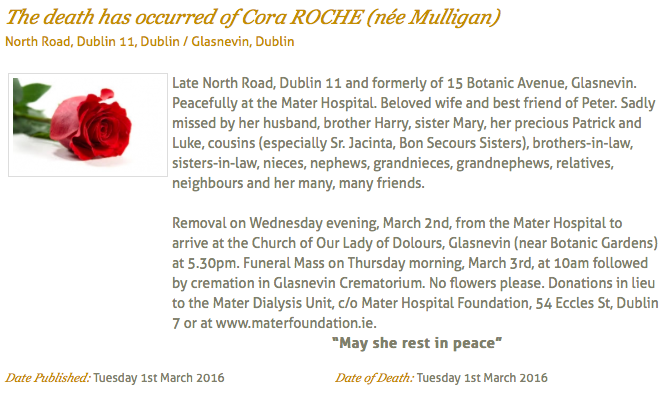
Last night, we went to Cora’s ‘removal’ – something that doesn’t exist in Germany. Pádraig ‘told’ us that he wanted to go. It’s when the body of a person is brought from where it was (home, hospital) to the church. There was a short service and we met a lot of old friends, among them Cora’s husband Peter. To Cora and Peter, Pádraig had been like a son. For many years, Cora had minded Pádraig (he was Patrick then; he hadn’t changed his name yet:), like her own son. Even when Patrick had become Pádraig, all grown up, she came over to our house, especially Christmas. Every year, Santa got into real trouble because he had such a hard time matching Cora’s generosity.

Unknown

This morning, I walked with Pádraig to Cora’s requiem mass. Again, he had ‘told’ us that he wanted to go. And it was so good that we went. Both the priest in his homily and a family friend who talked about Cora’s life with Peter mentioned Pádraig and the role he played in their lives a number of times. This was not child minding. This was family and love. They were so happy that Pádraig had come to Cora’s funeral mass.

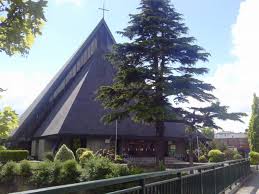
The church all these services took place in is known locally as the ‘wigwam’. It’s the church Pat and I got married in. It’s the church that Pat’s mother had gone to the evening of the big storm that blew her over when she was leaving the church after mass – a blow she never recovered from. It’s part of our life and family ‘history’.

The removal last night and the mass this morning made me stop in my tracks. It stripped my life, our life, down to its essence. While I probably have my own ‘version’ of faith, I always recognise it in the readings and, often, in sermons and teachings.

At the centre of it all is love. It’s that simple.

Whatever worries we have, whatever seems to be important to us, whatever decisions worry us, whatever possessions make us tick, whatever mess we think dominates our life — none of that really matters. At the end of the day, it’s all about the people we love. Nothing else.

Cora gave me a glimpse of what that love means, how this love affects those who are loved.

Tomas Ó Criomhthain ended An t-Oileánach (The Islandman), his book about the wild Blasket Islands out off the west coast of Ireland and his last inhabitants, by saying:

I have written minutely of much that we did, for it was my wish that somewhere there should be a memorial of it all, and I have done my best to set down the character of the people about me so that some record of us might live after us, for the like of us will never be again.

The like of Cora will never be again.

But the world keeps turning and there are many young people with such big hearts and such an amount of energy, commitment, and love that there is no reason to worry about our future. It’ll just be different.

Seomra na Gaeilge

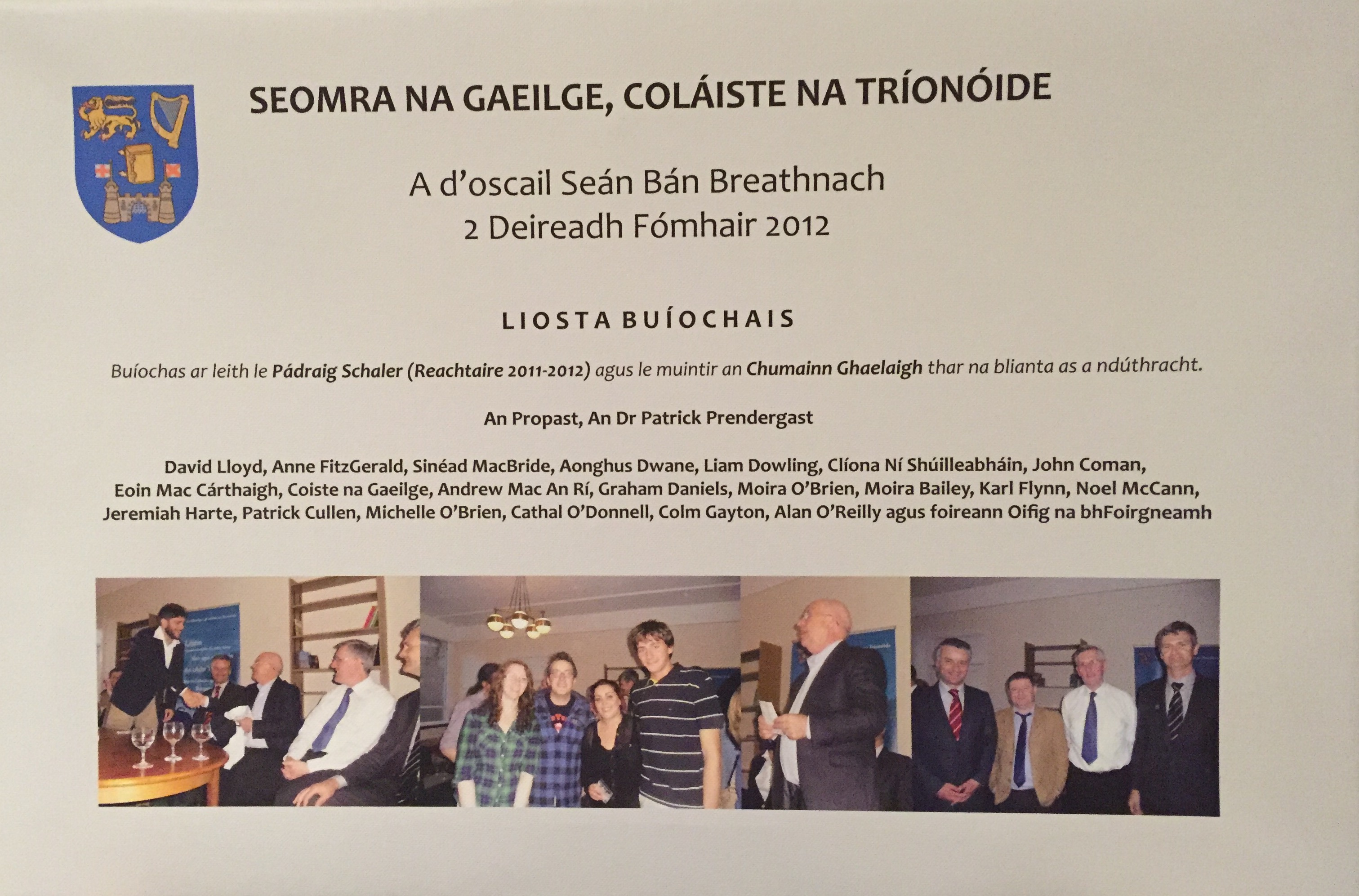
Tonight, three of Pádraig’s lecturers from TCD came to visit and they brought this with them for him to keep for the night and to be returned to TCD tomorrow.

FullSizeRender

I had never seen this. I have never been in this room, Seomra na Gaeilge, that he had worked for so much – though I’ve seen signposts on TCD campus pointing towards it. How proud he was when this room was opened. How proud I am to see this big picture that hangs on the walls of that room he had pushed for so hard.

Other things happened today. Nothing that would compare to this.

No more whinging

The movie about persons with ABI arrived, in German, but without the subtitles. They arrived in a separate MS Word file which I’ll have to somehow mix into the movie. Nothing easier than this for an experienced localisation veteran, you might say! (Don’t worry if this doesn’t mean anything to you. It’s absolutely and utterly boring.) Instead of relying on my own veteran experience though, I asked a good friend what to do next and we are on the way of solving the problem. Some time, in the not too distant future, we’ll organise a BIG view of “Wärst Du lieber tot?” – maybe even with the Director herself. How knows.

I also heard from the Dominican Sisters who I had asked about space for An Saol’s therapy centre. They are considering the request. The letter they sent was incredibly moving and christian. Of course, ‘christian’, you might say, they are, after all, a catholic order. But for me, it went far beyond what someone in a certain position and from a certain background would be expected to say. – Turns out, and I don’t think the writer of the letter knew this, everybody in our house, except myself, was educated by the Dominicans at some stage in their lives. Our kids in Scoil Mobhi, Pat and her sister in Eccles Street. For me, the letter had echoes of Scoil Mobhi, which was the school I would have liked to go to myself, had I had the chance (I didn’t;). In addition to the encouragement, compassion, and verbal support they expressed, they sent a cheque for 5,000 Euro for An Saol, to cover the cost of some equipment or therapies.

It was the expression of trust and encouragement in An Saol and the work we are doing that moved me most and will most motivate me over the coming months.

Here is the commitment: according to my plans (how good they are I’m sure I’ll soon be told by an expert), it’ll cost 1.5m Euro to fund the 3-year An Saol Neuro-Therapy pilot project for (ideally) 3-5 survivors. With your help, this is the money we’ll raise, (ideally) with the help of the Irish State.

images

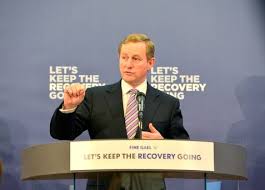
As Enda Kenny, our outgoing Taoiseach, said: no more whinging, we know what we need to do.

Right?

Elephant

Today Pádraig went to hospital – BUT, for the first time, not to be treated; instead he came with us to visit someone close to us. Going to a hospital isn’t something you’d like to do. And while this wasn’t a happy occasion either, it was nice to meet family we hadn’t seen for some time.

The film ‘Would you rather be dead?’ (Wärst Du lieber tot?) arrived – only that I couldn’t find the English subtitles. Maybe I’m making a mistake when I’m trying to play it, but I will be in touch with the production company tomorrow to find out. We need to get this with English subtitles. It’s such a powerful film.

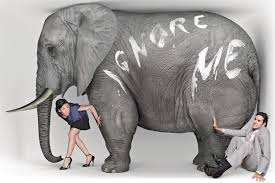
It’s calling by name the elephant in the room.

Unknown

Asking the most difficult of questions. And getting the answers from those affected: No. Not dead. I want to live. – Once we get the right subtitled version working, we’ll find a cinema or a big hall and organise a big big showing.

There are so many things pending that really need to be ‘fixed’: like the space for the An Saol Sara Walsh Therapy Centre, sufficient staff, a better presence on the internet, clear and unequivocal political support, HSE support, fundraising, …

We’ll tackle them, one by one, starting tomorrow!

StandingUp (for your rights)

Today, Pádraig stood up – for his rights.

This is a slightly long story. About just one issue. But, I think, worthwhile telling. And thinking about. And wondering: how is this possible in a civilised society?

Last summer, and you’ll probably remember me writing about this, I sent all the details about Pádraig’s care at home in Hamburg to the relevant people in Dublin, so that they would know what would be required for Pádraig in Dublin.

Pádraig had been assessed by doctors. We had lived with him almost nine months. I forwarded the specs and the prices for his equipment. This was going to be easy.

Just over two weeks ago (i.e. 5 months after Pádraig’s arrival in Ireland), a rep with a therapist measured (again!) the height of Pádraig’s room to make sure the standing bed would fit in.

Last Wednesday, at a meeting, we heard that Pádraig’s standing bed could still not be ordered because the right mattress had not yet been sourced (the rep had suggested a 2.1m mattress for the 2.3m standing bed – remember, I had forwarded the spec. for the right mattress and the details of the company selling it last summer).

Here now starts an even more amazing part of the story.

Last Friday, a therapist (without clearly communicating this to us) called Pádraig’s GP practice because they had become worried about Pádraig’s oxygen levels after a visit to see him the previous afternoon. Yesterday, both Pat (at home) and I (in Berlin) were surprised to get phone calls from the practice and then a visit by doctors – out of the blue. But – as we all know, lack of oxygen can be very serious.

There was a problem with Pádraig’s oxygen levels, sadly but not so surprising — as it was almost going to be expected: anybody not standing and not being mobilised for months will develop these problems. First year medical student knowledge.

This is why we had taken the initiative about a week or two ago and ordered a tilt table ourselves – basically, a therapy table that can ‘stand up’. We were not prepared to put Pádraig’s health at serious risk any longer.

After a bit of research, we ordered it from Poland where it was tailor-made for Pádraig and shipped to our home for less than half the price and in a quarter of the time it would have taken had we ordered it from a supplier in Ireland. (I hear you all asking: what???)

When Padraig stood up this morning, for the first time in months, in his brand new table, his lungs cleared, his oxygen levels went back to normal.

Having stood up, finally, in the standing-table, having felt his body on his feet again, this afternoon, he achieved another few PBs when cycling the MOTOMed. He cycled 2.5km at 42rpm – on his own.

I am tempted, but won’t, list all the things that went wrong here and won’t point out where it all went wrong and who was involved. Even as a non-expert, you’ll see that by yourself.

Not standing up for such a prolonged period of time significantly increases the very serious risks for your well-being, if not your life. For anybody – and far more so for someone with such serious injuries as Pádraig’s.

In my opinion, denying him, for months, the possibility to stand up is a violation of a long list of Pádraig’s rights – patients’ rights and basic universal human rights.

Someone said to me recently: in years to come, there will be an enquiry into how persons with severe acquired brain injury were treated in Ireland. And there will be an outcry and people will ask: how could we have allowed this happen?

We have the opportunity now to stand up, with Pádraig and others, for their rights.

Collectively, we can stop this injustice, the ill-treatment of the most vulnerable.

Choice – Poll for Life

Run. I’ll sing it one last time for you, then we really have to go. You’ve been the only thing that’s right In all I’ve done. And I can barely look at you, but every single time I do I know we’ll make it anywhere, away from here. Light up, as if you have a choice even if you cannot hear my voice. I’ll be right beside you dear. Louder. louder! And we’ll run for our lives. I can hardly speak I understand why you can’t raise your voice to say. To think I might not see those eyes makes it so hard not to cry and as we say our long goodbye I nearly do.

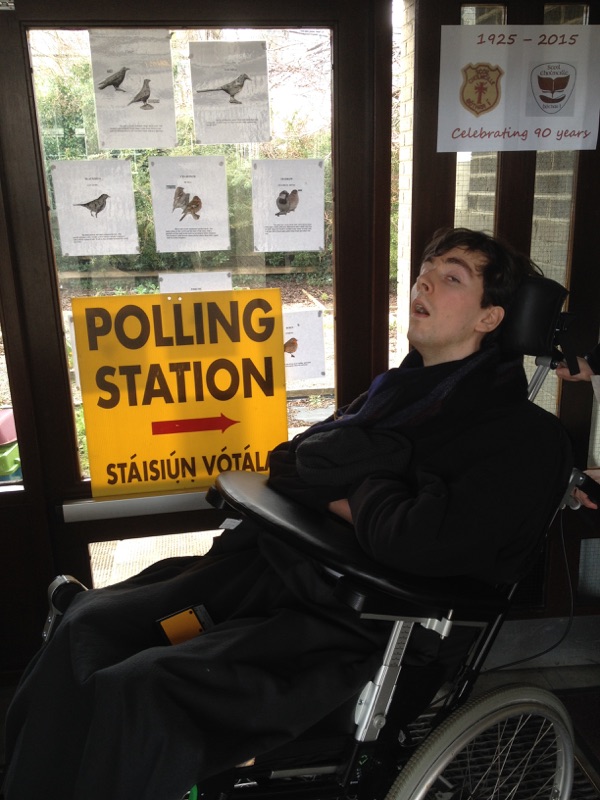
Everybody has a choice. In elections (like today). In life (like every day).

IMG_0965

Isn’t that absolutely fabulous? Taking charge. Pádraig making his choices. Like them or not. Isn’t this what it is all about?

Not about meetings. Not about people covering their backs. Not about people worried about what’s not theirs. Not about reports. Phone calls. Patronising decisions. Making decisions on behalf of others. – It’s about Pádraig making his choices. For candidates and parties. For life.

P H A N T A S T I C.

And you know what? – I bet his vote will make all the difference. I mean that. In so many different ways.

Back to Berlin. Or is it ‘from’?

Made some great contacts at the Hannelore-Kohl Stiftung’s “Nachsorgekongress” (Conference on After Care) and learned a lot about how the support for survivors of ABI is constantly evolving in Germany. I have discussed some initial easy-to-realise collaboration with the Hannelore-Kohl Stiftung and with the Selbsthilfeverband Forum Gehirn (Self-help Group Brain Forum) for persons with an ABI and their families. Also learned a new acronym: MeH, Menschen mit erworbener Hirnschädigung (People with ABI). As there was also a French group of people affected by ABI, to me it looks like as if there was good chance of a European Initiative in the making for some time in the future.

It is strange phoning home to find out how Pádraig and everyone is doing. Can’t wait to get back. — There was a lot of reassurance from people here in Berlin that what we are doing is the right thing. Life continues, maybe life is different, maybe it’s a different life (on person affected said that this is his ‘second’ life). They all highlighted how important mobility and inclusion is. One incredible (but perfectly logical) point various DOCTORS made was that every opportunity for ABI survivors to move and to feel their bodies was crucial AND that transfer in a lifter was absolutely ***inappropriate*** in this context. I wonder if that figures in the education of physios and OTs.

I mentioned in a previous post that I wrote up a draft proposal for “Teach An Saol”. Here are the links:

I also mentioned that I was going to share some quotes from draft reports prepared by Irish Experts on neuro rehabilitation. Note that this is not final and not signed off. It’s a bit long, but worthwhile reading it.

There is a significant body of international evidence to support the benefit and cost effectiveness of specialist rehabilitation services within a modern health service. In Ireland there are profound resource and delivery gaps in rehabilitation services when compared with those in other European countries. Chronic underinvestment and the lack, until recently, of a coherent national strategy to guide the development of neurorehabilitation services are the principal contributors to this position.

Emergency trauma and medical care in now more responsive and effective; more people are surviving catastrophic injuries with complex, life-changing neurological, vascular and orthopaedic effects. This has led to an overwhelming unmet requirement for specialist rehabilitation services particularly for people who have sustained major central nervous system injuries. This is evidenced, for instance, by the inexorable growth in numbers of people with newly acquired complex disability after neurological injury on a national specialist rehabilitation list.

Many community residential options for younger, severely disabled people do not meet their unique needs where continuing slow functional recovery is possible over many years after their injury. Development of more structured community based rehabilitation teams is required to support patients during gradual step-down from tertiary centres and regional units so that they can be supported in reintegrating within their local communities. New funding paradigms that recognise the unique and complex long-term requirements of severely disabled survivors of catastrophic illness or injury require urgent consideration. One suggestion that warrants closer scrutiny is that of ring-fenced central funding allocated after detailed needs assessment.

Effective and realistic goal setting, with patient and family engagement, across the continuum of recovery and service delivery, is the cornerstone of the rehabilitation process. Timely access to acute and post-acute specialist rehabilitation in facilities equipped to treat patients with complex rehabilitation needs must be realised to optimise the functional recovery of those who survive catastrophic injuries and illnesses. Expansion and standardisation of community rehabilitation services is essential to ensure that the benefits of post-acute rehabilitation are sustained and reinforced as patients make progress in their new lives.

I think our proposal, if supported by the Health Service, would go a significant way in achieving what the Irish experts say needs to be done.

Wouldn’t it be great to collaborate on this exiting project and, together, celebrate the improvements to the current services, and, more importantly, the huge improvements in the condition and quality of life it will bring to survivors?