SummerWalk

I don’t remember a summer when the grass on the dikes was just brown and burned and non-existent. That’s what we saw when we went on a walk in Westerhever. Walking up to the last dike wasn’t that bad. People were sitting in their (green) gardens and authentic Scottish highland cattle were grading in the fields. But then, approaching the dike, we could see, how this summer with nearly four months of no rain had changed the landscape.

It was nearly unreal. Even the fact that we were able to go out that late in the evening, finding the temperatures lovely (and not too cold), is so unusual for the North of Germany.

We’ll enjoy it as long as it’ll last.

The summer, the sunshine.

Life and living.


MovingArms

“I’m betting he’s going to swerve first”, said Phil in Groundhog Day as he was driving down the railroad tracks toward an approaching train. It’s something that would never happen. In real life. Nobody would drive down the railroad tracks and trains would never swerve.


Pádraig tried out a gadget today that supports his arm movements. He initiates them and the support structure helps him to move his arm – for example to mobilise his arm or just to take a Pringles and stick it into his mouth.

Never saw one before, newer tried one before.

To me, this is a little like the oncoming train swerving to avoid a collision… Magic. I’ve learned never to be happy with what I know. Or to assume that what I know is what is possible. Anything is possible. Dreamboaters!

Cube

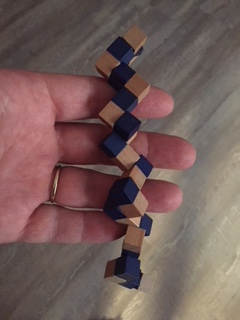
Pá,draig’s OT found this in her daughter’s drawer for things she isn’t using anymore but  could and should be used by somebody else. Apparently, and who would suspect this, it’s a cube. Or rather, with the necessary skills, one can re-assemble this into a cube. I tried a few times and reached a point when I thought: it’s not really more time I need. It’s something else…
It reminded me of a situation, maybe a year or two ago, when the answer to our concern about carers transferring Pádraig into or out of his wheelchair was that maybe not just two but three carers were required to do this transfer. It was clear to me, and I made that very clear to the agency at the time, that more people, numbers, were not the answer in this case.

There are times and occasions when less is more. And rather than numbers, skill is required.

Should Pádraig and I ever managed to finish that cube, we’ll post a picture. In the meantime, his therapist said, Pádraig should use it, together with many more items of the widest variety, to wake up, activate, and use his fingers and hands. Feel different structures, weights, fabrics ….

Another absolutely amazing things he did was swinging on a special swing suspended from the ceiling – one in a banana shape, and there was another (he didn’t try): a square board suspended at its four corners. Amazing, because – and who’d ever thought about this – if you are sitting in a wheelchair most of the time, you’re never exposed to the sensation of ‘swinging’ your body over the ground. Something people who walk do all the time. Think about it! It’s a type of sensory deprivation that isn’t so obvious.

On a different note.

Figure this: a few days ago, the Neurological Alliance of Ireland issued a news release stating that as of June 2018 over 4,000 people are waiting more than 18 months to see a neurologist. As a reminder, to my knowledge, and I am open to correction, the National Brain Injury Programme at the National Rehabilitation Hospital (NRH) has no neurologist, nor an EEG.

And last but not least.

Just came across a German band from Hamburg, I didn’t know. It’s called “Kettcar” and they have a new song out called “Trostbrücke Süd”. Here is an amateur but pretty cool live recording of this song.

Uncomplicated

Life is easy in Eiderstedt, in the North of Germany, close to the Danish border. Music is loud, you can choose between Bratwurst or Currywurst, a beer and a short (‘Kurzer’), and only pedestrians are allowed passing through narrow spaces between houses.

This is Germany’s second smallest city, Garding, on a Tuesday evening, just a few hours before it gets really packed and mad. All in a straight and simple way. People don’t talk much here. They take life as it is. Wat mutt, dat mutt. Whatever will be will be.

And Pádraig was right bang in the middld ov g all!

Kirschkerne

The general idea is that whatever happens to your feet, it can be felt and is connected directly to the rest of your body, and especially your upper body, including your face.

There is an absolutely brilliant OT in the North of Germany, just a few kilometres down the road from Tating, who has seen and worked with Pádraig a few times now, each time over a number of sessions, trying out slightly different approaches, most of them based on the methods and approaches developed by the Argentinian rehab doctor and specialist Castillo Morales.

Today, she worked with Pádraig’s feet, starting with a huge box full of cherry cores (or: Kirschkerne) – which are sold in big bags on the internet.


It’s incredible to see what those cherry cores can kick-off, how they feel on your feet, and how they can work not just with your feet, but with your senses. When Pádraig moved his feet through those cores, when he grabbed them with his hand, held on to them, and then opened his hand slowly to let them ‘rain’ back into the box – he was wide awake and alert. You could see the effort it took him to move his feet through the cores, how they stimulated not just his feet, but how that stimulation worked its way up through his whole body. It was like magic.

And as many of the most effective things we have encountered: it couldn’t be simpler.

North

The northern coast of Germany is, largely, a national park. They must have got a special dispensation today. Or, they might not have been aware that noise can pollute the air as badly as smoke emissions.

We went up to St. Peter-Ording Bad today, to go for a walk through the dunes up as close to the North Sea as we could. Up to the restaurant Pádraig wanted me to buy some years ago. The one that his aunt and her husband ran for more than 20 years.

The famous restaurant chain “Gosch” managed to get a license to set up business right on the dike a few years ago, with a shop owned by the town’s mayor in the annex. In the summer, they organise life music right in front of their premises. Not so bad, if they managed to control the level of the sound a little. Today, we could hear it right up to the sea front, about a mile. So much for the famous national park, protection of nature, and a Helene Fischer tribute band entertaining the masses.

We’re still tired from the journey, but recovering. Pádraig likes it up here and tomorrow we’ll start visiting the auld haunts, places where we have spent summer day together for decades.

For me, the North is full of ghosts. My mother, my father, my sister, her husband – all present though all long gone. It would have been my mother’s 95th birthday today, a day we often celebrated up here with “Kaffee und Kuchen” and a big BBQ in the evening. With our kids coming up to wish her well. All past. All present.

Tyre

First thing this morning, a car check.

I became clear immediately that half the back right hand tyre had disappeared.

So it was ‘just’ a matter of buying a new tyre – which turned out to be much more complicated than anticipated. In the end, someone really nice drove us an hour East, where a tyre chop, out in the middle of nowhere with one foot in The Netherlands, had the required size.

We made it to our destination – but now, I’m so tired, I’ll have to go to sleep…

Rettungsgasse

We said good-bye and thank you this morning to Pádraig’s nurses and therapists and doctors. We had a tremendous time in Burgau. My head is still spinning with all the new stuff and ideas we encountered. So much to digest…

We left, I think, just after 2pm and expected to arrive in Münster at around 8 to interrupt our journey to the North Sea.

We arrived just after midnight, following traffic jams caused by cars broken down in ad                                                                                                                                                       roadwork spots, blocking lanes, and accidents that were so bad that the police closed the whole motorway. Drivers and other accident professional can no ew

And then, about 20km from our guesthouse, a huge bang, so loud that we thought a tyres must have blown out. But it wasn’t a tyre.

We made it to the Gästehaus. Really slow. Just about to go to sleep now. We’re completely exhausted. Will check the car tomorrow morning…

And we’ll stick with the ‘Rettungsgasse” – something through and through German!

StillStanding

Don’t you know I’m still standing better than I ever did, looking like a true survivor.

I can’t resist the rhythm of this song. Each time I hear it, it makes me dance. In a kinda funny way. Try it yourself. Listen to it. And if you want to watch the most wonderful weird amazing and strange video while listening to the song, choose this version.

Pádraig has been (still) standing a lot over the past years. Because standing is one of the most important activities for human beings. Ultimately, it keeps us alive. Looking at it the other way ’round: if you don’t stand and instead just stay in bed, long enough, you’ll die. It might take 7 years or so. But you’ll most definitely die. It’s that simple.

The other day, Pádraig and I were standing. Looking like a true survivor, he was.

And then, for the first time, Pádraig stood again, this time all by himself. He had some help and support to do so, we were close by to assist when it was necessary, and he just managed for a short while – but he did it. He stood there without any of us helping or assisting him. Nobody to lean on.

Pretty spectacular.

Doors

You know the day destroys the night, night divides the day – Break on through to the other side... is not only a song by The Doors. It describes what research is all about: opening Doors and breaking through to the other side.

The pictures below show an ‘old hat’, apparently, at least that is what the coolest of the cool researchers would call it: 256 electrodes connecting to the brain to produce a high density EEG. Although it’s an ‘old hat’ (for some), it’s the only one being used in a German clinical environment, I’ve been told. It is  that expensive and it is that specialised. It allows an analysis of how consistently the brain reacts to instructions, not just demonstrating brain function but also serving as a first step to the tuning of a computer that would then be able to interpret different brain signals corresponding to commands, such as ‘on’ or ‘off’ or ‘right’ and ‘left’ and ‘stop’ and ‘go’.

It’s an ‘old hat’ because the researchers, those ‘way out there’, are disposing of ‘hats’ altogether, implanting electrodes directly onto the cortex, connecting with ‘machines’ via bluetooth. – Rings a bell? To me it sounds like as if I’d seen the movie!

The other machine, the one with the black ‘saucer’ in the photo on the left, allows the  measurement of what is called “Motor-Evoked Potentials”. It checks whether the connections between the brain and the ‘extremities’, such as the fingers on each hand, are still functioning. Because if they do, and a patient cannot control one of these extremities, then researchers know that at least there is a potential to ‘revive’ or re-charge these connections.  The “MEP” can also help to show how functions originally located in one part of the brain are now active in another part of the brain, e.g. in the case where the original location was injured and the brain ‘re-wired’ itself.

I have never come across any of this before, although I was told today that at least the MEP is now part of standard procedures in neurological treatments, and especially in the case of an acquired brain injury.

What could be shown with these kind of devices and examinations is that it would give (near to) ground certainty in the company of experienced assessors to which extend the brain is rewiring itself.