Augsburg. And Art.

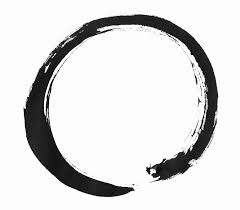
The German word for “centre” (Mitte) and a spiralling circle around it. Nothing pointing in any particular direction. It was a happy moment today when I saw this piece of art in the office of the man in charge of the Aftercare Centre in Augsburg, the (charitable) “Nachsorgezentrum” built by Mr Schuster, a few years after he had built the Therapiezentrum in Burgau to cater for persons with acquired brain injuries who had left hospital and early neuro rehab, but could not (yet) live by themselves or at home.

Check out the ingenious pieces of art, made from simple wooden palettes, in the centre’s workshop.

I had planned a visit to the centre for the past few years and this afternoon it finally happened. It is the most amazing purpose-built place to live in for persons with an acquired brain injury, with only one other similar centre being around in Germany, in Bad Tölz, in Germany’s deep South, deep Bavaria. And none I would know of in Ireland.

There is an ‘old’ part and a ‘new’ part, and both are outstanding. However, it is the new part that really shows off the skills, experience, and passion of the people (really: the person) who planned it – and who I met today.

I never knew why places I had visited previously always reminded me of nursing homes. There had always been a ‘clinical’ air about but I had not been able to put my finger on what had caused this, even when the people running them had the best of intentions to create a homely feeling. Today, all of a sudden, I realised why: because all those other places had long straight very functional corridors, and many of them had been painted in ‘calm’ brownish or clinical white colours. Here, there almost were no straight lines. the corridors were curved or the straight lines were interrupted by alcoves and open spaces – all in bright lively colours, with some funky ‘accessories’ interrupting and breaking up the otherwise bare walls.

Someone once told me (and must have told the designers of the centre in Augsburg) that you can never have enough space if you are using equipment and wheelchairs. There were not just art rooms, computer rooms, therapy rooms, quiet rooms and meeting rooms – there were also rooms to store equipment and a ‘garage’ to park (and recharge) all sorts of electrically powered cycles and chairs.

On both sides of the house was a really wide balcony, allowing a wheelchair user to go for a ‘walk’ and get a bit of fresh air – and even to pass another wheelchair user coming down the opposite direction. The house has living units each for about six persons having their own, large en-suite room and sharing a sitting area and an open plan, especially adapted kitchen. Each unit has been built so that it could, in the future and if needed, be used for other purposes involving persons requiring help and assistance.

The philosophy of the centre is that people do or get involved in everything a healthy person would be doing, such as cooking or washing their clothes. There is no pool in the house, so that people who could benefit from aqua therapy “have to” get out of the house and go to the pool – like a healthy person would do. This is also the reason why the building is very close to the city centre and all of its amenities, from public transport to shops and cinemas, but also a zoo and a small botanic garden.

What was equally exciting as visiting and seeing the centre at work, was the long conversation I had with the person who is in charge of the place, and to learn about his approach. For example, they have set up three different therapy praxis’ (physio, OT, and SLT) which not just serve the residents in the centre, but also persons in the community who require access to their highly specialised neuro rehab services. That way, they make the best use of their staff and, at the same time, generate an income for the centre (which helps them covering their running cost and paying staff).

Talking about running cost: we spent a good while going through a top-level cost estimate and reached the conclusion that the average amount currently paid for by the HSE for home care packages or to nursing homes would be sufficient to cover the daily rate we would have to charge in Ireland for a future An Saol Centre (with residential, respite and day units).

I have the feeling that, looking back in a few years time, I will remember this day as the day that plans for a permanent, purpose-built centre in Ireland for persons with a severe acquired brain injury took shape.

And here is what I missed while I was away: Pádraig went to the Hugh Lane Gallery which does not only have beautiful works of art (and some weird ones), but also a café offering beautiful cakes. Who could enjoy art on an empty stomach, I ask you? Sensible as he is, Pádraig decided “cake before art” and went for it in the proper order.

Just for those of you not familiar with the pieces exhibited in the Gallery: what looks like  an auld brown wall carpet from the sixties is, in fact, a piece of art by Sean Scully called “Light/Alba”. And the second piece on the pictures above , the one that might remind you of baby Jane, is, in fact, a piece by Niamh McCabe and it is, I’d never have guessed it, a dead painted bird. I have it on a reliable source that Pádraig was wondering whether Niamh killed the bird herself so she could paint it – or whether she had a cat who collected birds for her…

What do you think?

(You’ll have noticed that I had time on the plane back:)

Bridges and Tunnels

It’s not the ships passing underneath the bridge, its the bridge passing underneath the ships. Sounds mad?

Well, the bridge, officially opened today by Chinese President Xi Jinping, is the world’s largest bridge. Across 55 km, it connects Hongkonk with Macau and the Chinese mainland. It took nine years to complete and cost US$20 billion.

For comparison: the shortest distance between the North of Ireland and Scotland is just 12 miles or less than 20 km. – Although, to my knowledge, nobody has ever considered to build a bridge here.

What I found most interesting about this bridge is, and here comes the “mad” bit, that a 6.7 km stretch of it is not a bridge at all, but a tunnel between two artificial islands, designed to allow ships pass freely through (above) the path of the bridge, well: the tunnel.

Seems they couldn’t make up their mind. Bridge? Tunnel? – Well, let’s do both. There’s enough of a distance not to exclude any of those possible options, eh?

Crazy people.

Personally, I’ve always liked the idea of a tunnel. People are always talking about ‘bridge building’, not just between places, but also between communities, political parties, countries and their people.

As we know, bridges tend to collapse. Have you ever heard of a tunnel collapsing? No.

Last time I came here, I drove and needed ferries, bridges, tunnels and a lot of time to get here. Today, it felt like I was beamed here.

Tuesday is, of course, swimming day with Pádraig. Thankfully, I’m feeling a bit better today, still not great, but good enough to get into the water. I don’t think I could ever explain how happy I am when I see Pádraig enjoying floating around, kicking his legs, walking across the pool, standing, with very little help from us, on the site of the pool, holding on to the wall. For him, it must be one of the most liberating experiences of the week. To float, to control his movements with so much ease, and to have fun. Today, we were practicing the back-crawl start, pushing yourself away with your feed from the wall. It was fantastic!

After swimming, I got a lift to the airport and now, just a few hours later, I’m back in Burgau for the night. I’ll be meeting a few people tomorrow in the Therapy Centre and will be visiting an Aftercare Centre (also built by Mr Schuster and his foundation) in nearby Augsburg, before returning home in the evening.

It still amazes me, how travel has changed. And, in a way, I wonder, whether stuff like bridges and tunnels are not artefacts of the past….

Circles

Businesses have to expand. The economy has to grow. Our cars have to get bigger. Our holidays more exotic. Our houses more lavish. The food fancier. Our clothes more extravagant.

All pointing in one direction: forward.

What about standing still for a moment? What about doing nothing? Rest? Allowing the busy-ness of the world surrounding us do their thing while we walk, not ahead this time, but around in a circle?

One story I’ll never forget it that of a young woman who had travelled India for three months. She was completely exhausted and decided to do some kind of mindfulness/yoga course in Sri Lanka to relax. One of the first exercises was to sit and do nothing for five hours. Nothing.

She said that she found those hours more difficult than anything she had encountered during her three-months travels across India. And this was just the first of many similar exercises.

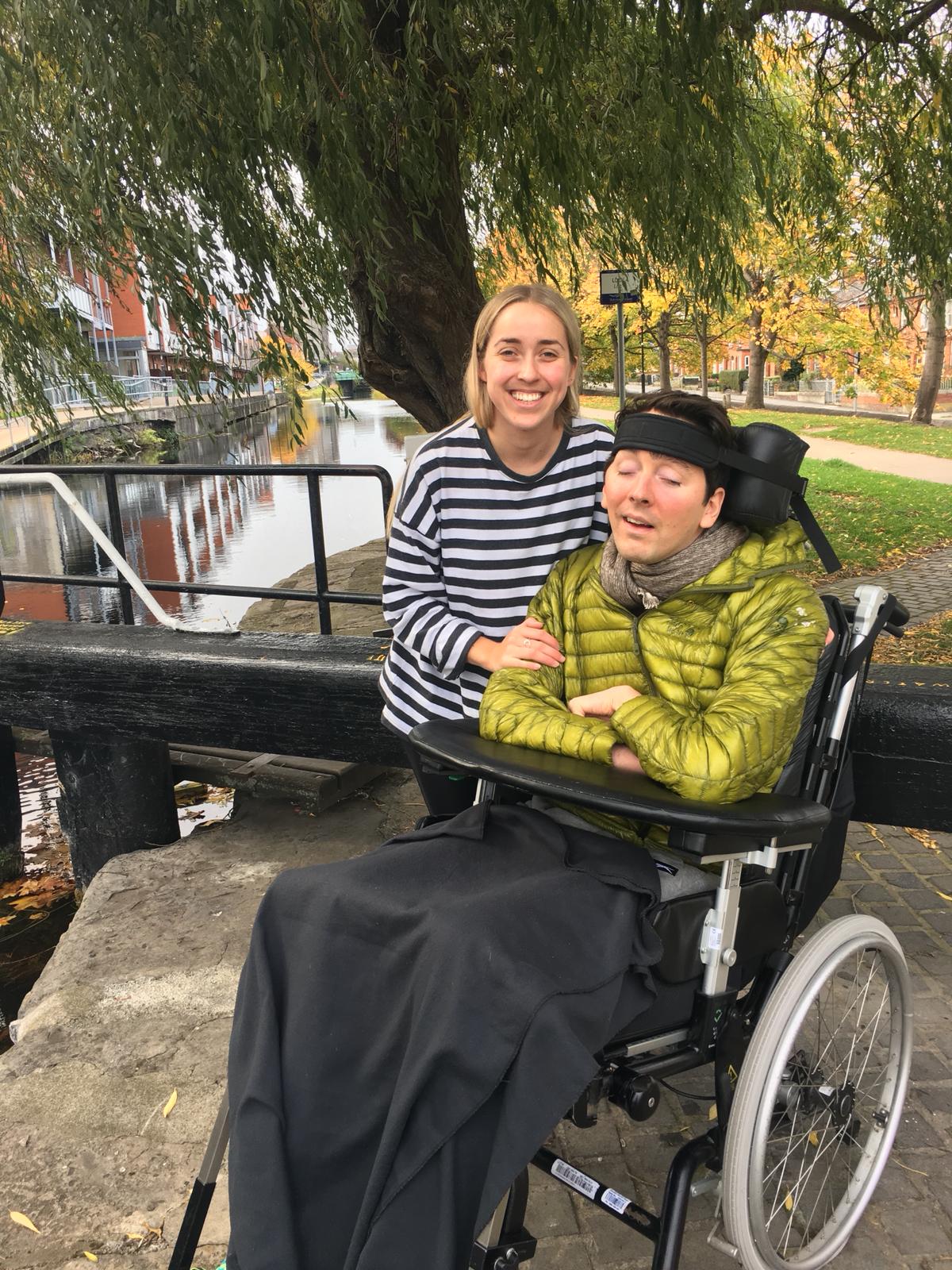
I have been thinking of this in the context of therapies. I have observed this tendency to celebrate achievements following exercise/therapy: look what Pádraig can do! Lift his pelvis off the floor, push his wheelchair across his room, hold his head all by himself. All of this is great. All of this is necessary.

But only if it has a purpose and a meaning. Only if it is not done ‘per se’. Only if it not done just for its own purpose.

What is happening in therapy must have a meaning for Pádraig’s life. It must enable him. It must allow him to do something he wants to do. At the centre of everything, the focus, must be Pádraig feeling that he is alive and that he lives with us in community. It can never be “look what Pádraig can do” but must always be “brilliant what you can do”. Never a performance, always integration.

Pádraig has figured out with us how to survive his catastrophic accident. Pádraig has figured out with us how to improve his physical condition using therapies. Now we have to figure out how to make life together the best it can possibly be (while not forgetting the need to survive and the need to exercise).

And for that, we might, for a moment, have to stop and pause and go around in circles for a change.

WhatElse?

In a little bit less than a month’s time, I’ve been writing this blog for five years. Every day. For many different reasons.

I’ve been hardly out of bed today so I had a bit of time to think and feel without the pressure to do something or the other.

At the beginning there was the disbelief, none of what I was hearing could be true and I would wake up one day and it had all been a bad dream. In fact, there were days when I woke up and thought that this is what had happened.

Then there was the urge to do something and the belief that if only the right thing was done all would change. Dramatically.

There was the outrage when we were told that Pádraig’s “pathway” was to lead him into a nursing home, on a minimum maintenance programme.

There was drama and heartbreak and almost unbearable intensity of life.

There was progress that no-one expected.

There is progress, a joy of life, an incredible bond and sense of purpose in life.

Love.

What else could I share here?

Gazillion

The world is made up by gazillions of details. No matter what world you’re living in. And when I listen to someone beginning to talk about the details I get this feeling that nothing will ever get done. I might have mentioned what a very good friend of mine once said: If you really want to stop something, don’t oppose it. Add to it enthusiastically. Add detail. Soon the whole thing will become unmanageable and it will be abandoned.

Reality does not conform to detailed plans. Checking on detailed compliance soon becomes an exercise “per se” without any meaning, incapable of dealing with variety of life, impossible to cater for variance and ‘exceptions’.

When I was still a student, I got a job teaching German to immigrants. Easy. I thought. Nothing more straight forward than teaching something you know doing (speaking) pretty well. Wrong. It was the most difficult job ever. Because I was trying to teach German the way I had learned languages, I was trying to teach rules (with dozens of exceptions) to people who had never learned a foreign language, and couldn’t care less about grammar, the minute details of gender, articles, and cases. Their needs were different from what I was teaching. Sounds obvious now but when I was doing it, it took me months to learn from my students about their needs.

Change gets lost in details. It comes in big strokes. Martin Luther’s dream was about the big issue. Revolutions are about big ideas, they drown and get lost in day-to-day bureaucracy.

I am not feeling at ease drawing up dozens of procedures based on existing practices for the An Saol Project day centre that is going to change the way we support persons with a very severe brain injury. Because if they are based on what exists, they will not bring change.

Rome was not build in a day. Slavery was not abandoned with the stroke of a pen. Equality will not be achieved overnight. We will need what the Germans call a ‘long breadth’. Persistence.

“We will never give up” is easier said than done. Enthusiasm and ‘long breadth’ are at times difficult to combine. But – if it was easy, someone would have done it.

I’m having a cold, having started to run again a bit and having started to go swimming a little. Hopefully, that I’ll get over that as quickly as I’ll be dealing with the gazillions of details of procedures and planning and fire regulation and disabled access and health and safety and infection control and minimum door widths and maximum distances. So I’ll have more time to spend with Pádraig.

Respect for Autonomy

The wound left by the PEG has been healing really well. It will leave a trace and a reminder of it on his stomach, but it will fade away. Together with the memories of constant pre-digested drip feeding, eliminating the very sensation of hunger and thirst, shrinking the stomach and eliminating all pleasures associated with food.

Yesterday, a father who attempted to murder his four children was jailed for eight years. According to the Irish Independent,

The judge said among the aggravating factors was the “narcissistic element” of the offences where the man had shown a “complete lack of respect for the children’s autonomy”, believing they would be better off dead.

A nurse in an Irish hospital, when we were standing beside Pádraig, had asked how the accident had happened and then said that it might have been better had he died. Knowing, had she thought about it, that Pádraig could hear her and that we had been fighting together for his life for more than two years.

Compare.

Speed

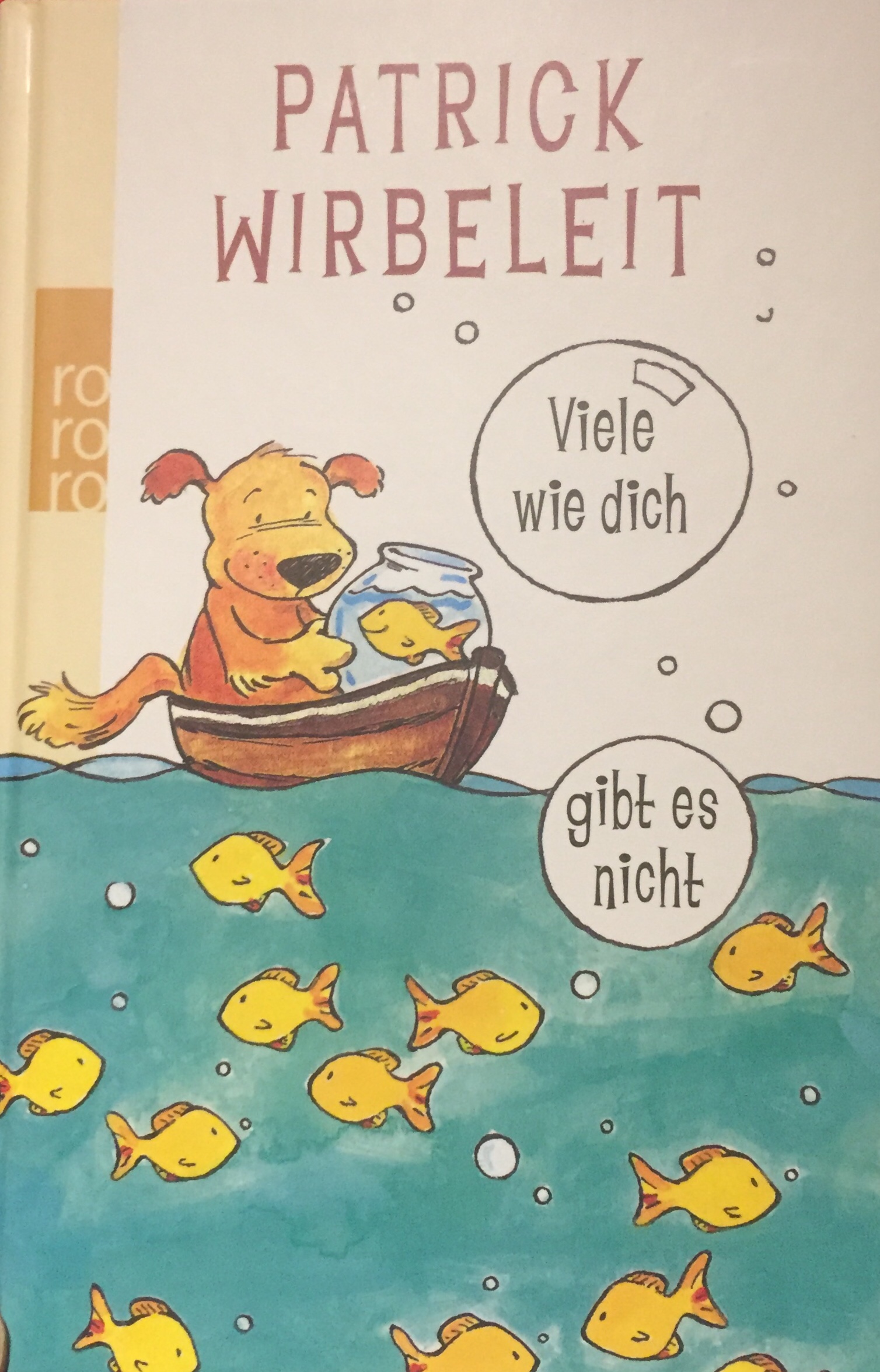
This book turned up called “Patrick wirbeleit – viele wie dich gibt es nicht”. It’s a book Pádraig got when he was maybe eight years old. He didn’t get it because at the time we thought it was a particularly great or exceptionally interesting book, but because of its name. You must have guessed it!

It’s hard to find a book with your name in the title – even if it is still a mystery to me what “wirbeleit” means. The subtitle, in contrast, is really nice: “there aren’t many like you”. No truer words said. We knew that then and, in a much more profound way, we know that today.

What I didn’t know then is how important the idea of him being in this boat was going to be to him and to myself. Maybe that’s where the Dreamboat idea originated.

The book is full of pictures about Patrick exploring the world and discovering new and exciting aspects to it. One of the best pictures in my opinion is the one that says that “many snails are not faster than one”.

The idea behind this is plausible. Yet, this is a more abstract version of very many concrete situations I’m sure you have experienced many times in your life. And they provoke strong reactions when I experience them. Snails are going to take their time. No matter how many of them are aiming for the finishing line.

What this tells me is that more people getting involved is not always the solution to a problem. And: there are times when it might be better to take things slow and easy while staying focussed. Because they just take their time.

Gratitude

I went for a swim this morning. And as I was about to get dressed and thought that my bag was quite light, I noticed that I had forgotten to bring a towel. This afternoon as I was on the way to Pádraig’s swimming session, I noticed I had forgotten my togs. Lesson: I can always get worse.

If you let it.

The trick is to be strong enough in yourself to deal with adversary. To be strong enough not to allow it to destroy you.

But above all: we all know that there is always something to be grateful for. There is always some good. By contrast, bad stuff is always and only distracting. It leads to nothing.

(I managed to deal with the forgotten towel and even the forgotten togs! 🙂

Truth

When I started writing this blog almost five years ago, I never thought anybody would read it. Apart from Pádraig’s friends who wanted to know how he was getting on in Hamburg. So I wrote about what happened. I wrote how I felt. I wrote about people that crossed my way. Our way. There were few things I did not write about. And when I did not it was because I did not want to.

That has changed. I have become much more conscious, because I have been told on several occasions, that I have to respect the privacy of others, even, and especially, if they are professionals. I have been told not to rock any boats too much because that could make things difficult.

I don’t like writing with scissors in my head.

Yet, it seems that there are things that need to be said that cannot be said because they would do damage if they were to be said. Sounds complicated? It is. At least for me. When sharing my personal perspective on what is going on should be simple. Because that is what I do. I share my perspective. Not the truth.

Pádraig continues to do well. In physio this morning, he was on a floor matt lying on his back with his knees up in the air, pushing his pelvis really high up towards the ceiling. The thing is, and I will get back to this one day, that it is becoming clearer to me every day that while therapy is necessary, integration and participation and love shown and received is the key. After that, everything else falls into its place. – What do you think?