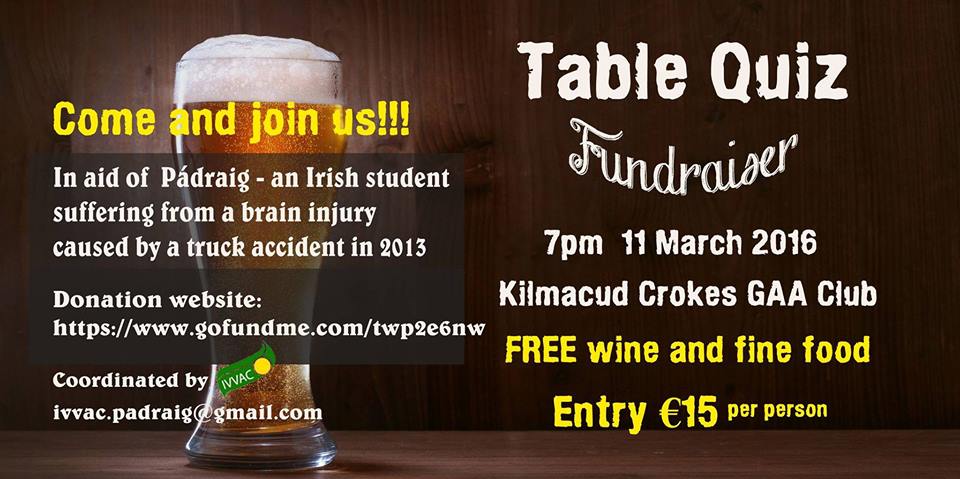
Please tell your friends and attend if you can!

10 Thursday Mar 2016
Posted in Uncategorized
Please tell your friends and attend if you can!
09 Wednesday Mar 2016
Posted in Uncategorized
In the end a few of Pádraig’s friends were available this afternoon to go on tour with us. Two of them came along, the others promised to join some other Wednesday. Just to clarify – no need to be able to drive yourself, what I need is someone to come along to watch Pádraig, just in case he needed help when I am driving.
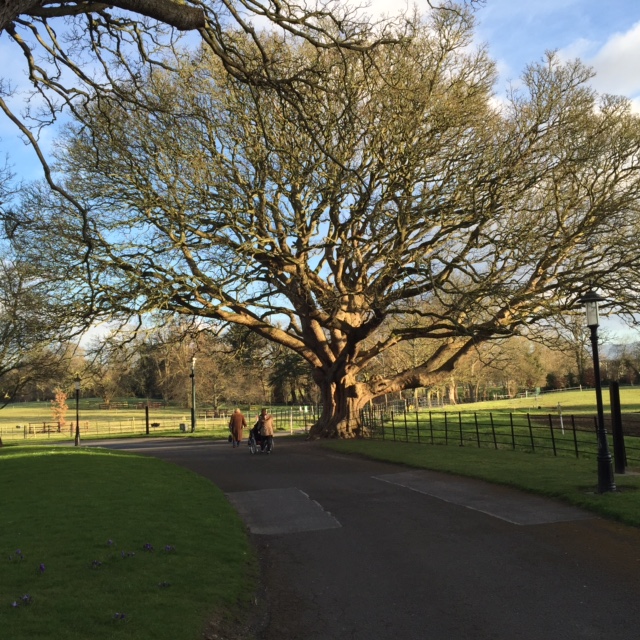
Pádraig under the tree – on the way back to the car park.
When the Queen comes to Dublin, or when Obama comes to down – they stay in Farmleigh. It’s an old house in a big park and, at some stage, it was owned by the Guinness family. Reason enough for the State to buy it, renovate it, and then use it to show off.
We got the last tour of the house, all for ourselves. It was bliss. And a bit silly, in a good way. Which chair did Obama sit on? Did the Queen have dinner on this table? Who can stay here? How much is a night?
Turns out a night in Farmleigh is one of those things you cannot buy. Like most important things in life. Money might make the world go ’round, but the moment the world stops spinning, its use evaporates.
These Wednesdays with Pádraig’s friends are turning into something really enjoyable and important. Hard to put into words exactly why or how. But really important.
Just in case: I’ll be in Germany for my mother’s first anniversary next Wednesday so will be going out again with Pádraig the following Wednesday, 23 March – if you were available to come along… that would be great!
08 Tuesday Mar 2016
Posted in Uncategorized
Up went Nelson, the pillar on Dublin’s O’Connell street, today 50 years ago.
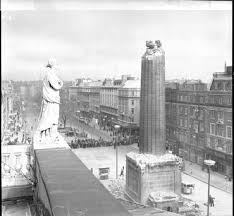
A little time later, the army installed another explosive device and, this time legally and controlled, blew up what had been left by the first bomb. Doing much more damage to the buildings in the neighbourhood than the original bomb had done.
Few, if any, regretted that the pillar, a symbol of British occupation, had gone. In fact, there was public support for getting rid of it, there are people saying today they had thought about blowing it up themselves.
Tomorrow, I’ll be going out with Pádraig at 2.30 – anyone free to come with us (I need some help to drive with Pádraig)?
We might make it down to O’Connell Street and have a look at where the pillar once stood.
What had been built for eternity vanished from the face of the Earth. In a few seconds.
07 Monday Mar 2016
Posted in Uncategorized
It’s more difficult to get out than to stay in. Only that ‘life’ happens outside.
This morning, we needed to ‘negotiate’ with a brick layer to get out of the house — our side entrance is being widened a bit to make room for Pádraig’s wheelchair.
We went to Croke Park to attend a ceremony in which an Irish flag was given to every post primary school in Ireland, as part of the 1916 (Easter Rising) celebrations. (This year, Ireland is celebrating 100 years of the declaration of the Irish Republic.)
It must have been the coldest morning on record. And the wheelchair spot in Croke Park must be the windiest and coldest spot in the whole of this magnificent 80,000 seater stadium.


Notwithstanding the cold, it was brilliant morning. We saw the President arriving with a motorcade of what looked like two dozen motorbikes. He gave a great speech about the vision the signatories of the proclamation had for the Republic they declared that Easter Sunday. And how much of this vision still remains to be realised.
Ryan Tubridy, one of Ireland’s best know broadcasters was leading us through the different parts of the ceremony. Seo Linn and the army band were playing. The national anthem was played. An actor explained what the ‘inventor’ of the flag Thomas Francis Meagher had in mind when he came up with the idea of the tricolour.
It was a brilliant day. For Pádraig and myself the first event we attended as part of the 1916 celebrations. – And tonight, we watched it all again on the telly.
On the way back up Clonliffe Road, crossing Drumcondra Road, and walking up St Alphonsus Road, I was thinking that everybody who doesn’t know Pádraig yet will get to know him around here. We will be out and about. How brilliant is that?
PS: Any ‘volunteer’ for the outing on Wednesday afternoon, at around 2.30, for about 2 hours?
06 Sunday Mar 2016
Posted in Uncategorized
I can’t say much about Mothers’ Day. It would all be speculation, guess work. I can just imagine that there is so much pain and so much joy there all at the same time. For all sorts of different reasons.

There was no smell of toast, coffee, and a (very burnt) fry coming out of the kitchen today in our house. Just the memory of it. The thing is that not just us but also our children are getting older.
Pádraig had a relaxed day today. Late breakfast. Late lunch. A walk in the park. In between banana milk, a spoon full of honey (for good health), steak, potatoes and broccoli. No strenuous exercises, no tilt table, not MOTOMed.
“There are miracles waiting to happen” is a saying I like.
While talking to someone in LA today who is rapidly becoming a good friend, we realised that miracles, extraordinary things, need space and opportunity to happen and to make a difference. This is what what I am looking for and will build, with the help of our friends, for Pádraig and other persons like him. An Saol will provide space and opportunity for brains to re-learn guided by the best ‘teachers’.
05 Saturday Mar 2016
Posted in Uncategorized
Madrid is full of boys named Paco, which is the diminutive of the name Francisco, and there is a Madrid joke about a father who came to Madrid and inserted an advertisement in the personal columns of El Liberal which said: PACO MEET ME AT HOTEL MONTANA NOON TUESDAY ALL IS FORGIVEN PAPA and how a squadron of Guardia Civil had to be called out to disperse the eight hundred young men who answered the advertisement.
This is the beginning of Hemingway’s short story , The Capital of the World.

The priest at tonight’s Novena in Gardiner Street Church told this story when he was interpreting the story of the prodigal son in St. Luke’s gospel. I suppose the idea is that we are all Pacos. We all have done something wrong in our lives and we all want our father to forgive us.
I was trying to calculate when I first went to the Novena in Gardiner Street. I think it was in 1987. It was 29 years ago. With Pat and her sister. Then, when our children were born, we brought them along. It was always so packed that there were people working in the Church telling us where we could stand.
There is a Novena of Grace prayer that is said each of the nine days, and it contains the lines:
I also ask you to obtain the favour I ask in this novena.
(Here pause to ask the favour you seek.)
But if what I ask is not for the greater glory of God, or the good of my soul,
obtain for me what is most conducive to both. Amen.
Each year I went, I prayed for the people in our family who needed it most, I thought. Never in my wildest dreams had I ever thought that one day, we would be bringing in Pádraig, in a wheelchair, and be praying for him.
04 Friday Mar 2016
Posted in Uncategorized
Give bikes 1.5m.
Because this is a safe distance to pass a bicycle.
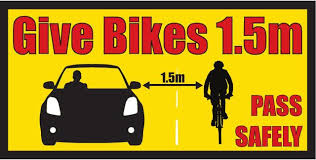 Give An Saol 1.5m.
Because this is the amount (by pure co-incidence) that we need to start a 3-year pilot project demonstrating how advances in neuro rehabilitation research can inform neurological rehabilitation leading to a successful recovery following severe Acquired Brain Injury (sABI).
(Anyone out there who could take this idea and design a brilliant campaign logo?)
I have shared the (draft) plan for the project with some experts, abroad and in Ireland, and with you here on the blog. I have also shared them with the HSE.
We’ll finalise the plan over the next week and launch the project in May.
In preparation of the launch, we will raise awareness with survivors and their families, politicians, practitioners, researchers, the administration, and voluntary organisations.
Teach An Saol – Life and Living with a severe Acquired Brain Injury (sABI) will become a reality. It will bring long-term neuro rehabilitation to people who take a long time to recover.
And we will raise the funding necessary to bring life and dignity to young people one way or the other. There is no alternative.
Pádraig continues to cycle the MOTOMed by himself. He’s half an hour on the tilt table every day. (To the best of my knowledge, the famous standing bed, while approved several times, has still not even been ordered.)
He and others in his position need An Saol (and the Dreamboaters:) to give their life a perspective, fun, hard work, company, hope, love.
PS: Yesterday, one of his carers asked whether he could hear. Not understand. Hear. What does that tell you?
03 Thursday Mar 2016
Posted in Uncategorized
Last night, we went to Cora’s ‘removal’ – something that doesn’t exist in Germany. Pádraig ‘told’ us that he wanted to go. It’s when the body of a person is brought from where it was (home, hospital) to the church. There was a short service and we met a lot of old friends, among them Cora’s husband Peter. To Cora and Peter, Pádraig had been like a son. For many years, Cora had minded Pádraig (he was Patrick then; he hadn’t changed his name yet:), like her own son. Even when Patrick had become Pádraig, all grown up, she came over to our house, especially Christmas. Every year, Santa got into real trouble because he had such a hard time matching Cora’s generosity.
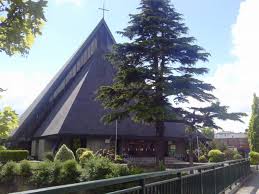
This morning, I walked with Pádraig to Cora’s requiem mass. Again, he had ‘told’ us that he wanted to go. And it was so good that we went. Both the priest in his homily and a family friend who talked about Cora’s life with Peter mentioned Pádraig and the role he played in their lives a number of times. This was not child minding. This was family and love. They were so happy that Pádraig had come to Cora’s funeral mass.
The church all these services took place in is known locally as the ‘wigwam’. It’s the church Pat and I got married in. It’s the church that Pat’s mother had gone to the evening of the big storm that blew her over when she was leaving the church after mass – a blow she never recovered from. It’s part of our life and family ‘history’.
The removal last night and the mass this morning made me stop in my tracks. It stripped my life, our life, down to its essence. While I probably have my own ‘version’ of faith, I always recognise it in the readings and, often, in sermons and teachings.
At the centre of it all is love. It’s that simple.
Whatever worries we have, whatever seems to be important to us, whatever decisions worry us, whatever possessions make us tick, whatever mess we think dominates our life — none of that really matters. At the end of the day, it’s all about the people we love. Nothing else.
Cora gave me a glimpse of what that love means, how this love affects those who are loved.
Tomas Ó Criomhthain ended An t-Oileánach (The Islandman), his book about the wild Blasket Islands out off the west coast of Ireland and his last inhabitants, by saying:
I have written minutely of much that we did, for it was my wish that somewhere there should be a memorial of it all, and I have done my best to set down the character of the people about me so that some record of us might live after us, for the like of us will never be again.
The like of Cora will never be again.
But the world keeps turning and there are many young people with such big hearts and such an amount of energy, commitment, and love that there is no reason to worry about our future. It’ll just be different.
02 Wednesday Mar 2016
Posted in Uncategorized
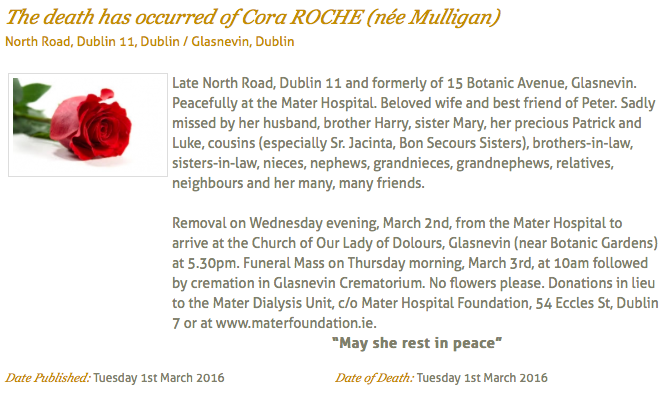
Very sadly missed by Pádraig, indeed, and all of us.
01 Tuesday Mar 2016
Posted in Uncategorized
Tonight, three of Pádraig’s lecturers from TCD came to visit and they brought this with them for him to keep for the night and to be returned to TCD tomorrow.
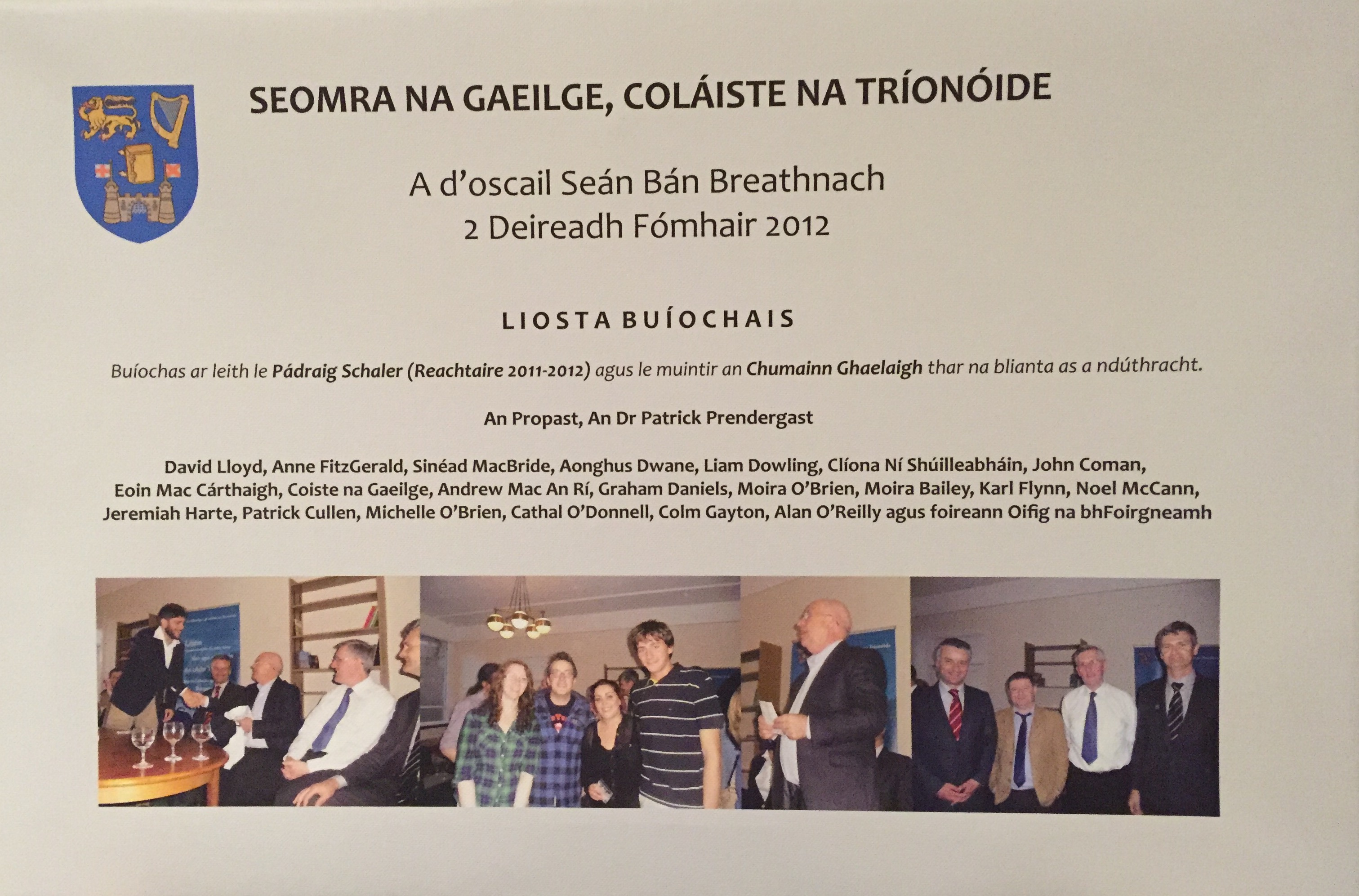
I had never seen this. I have never been in this room, Seomra na Gaeilge, that he had worked for so much – though I’ve seen signposts on TCD campus pointing towards it. How proud he was when this room was opened. How proud I am to see this big picture that hangs on the walls of that room he had pushed for so hard.
Other things happened today. Nothing that would compare to this.
 Hospi-Tales