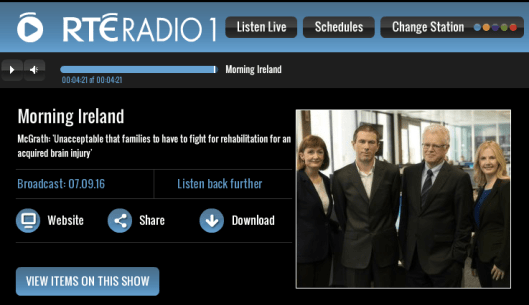
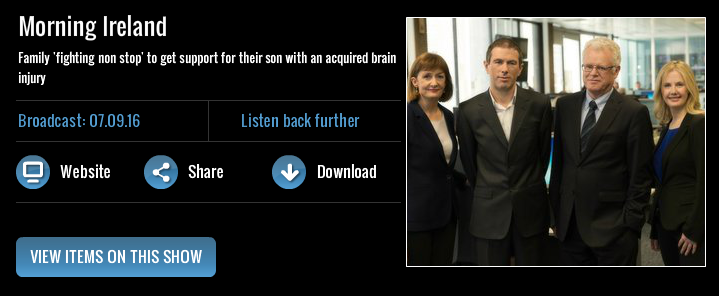
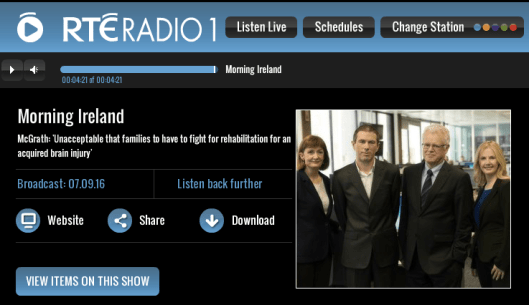
This one is for the experts. It’s the official reply by the HSE to questions put to them by RTÉ journalist Aishling Kenny in preparation of the pieces she prepared for Morning Ireland, broadcast on 6 and 7 August 2016.
First the questions and replies. Then some comments.
- Is there a programme to help people with severe acquired brain injuries?
The National Rehabilitation Hospital (NRH) provides comprehensive inpatient and outpatient services toindividuals who, as a result of an accident, illness or injury, have acquired a physical or cognitive disability and who require specialist medical rehabilitation.
The Consultant led Brain Injury Programme at NRH is backed by experience and clinical expertise spanning over 50 years. The Brain Injury Team works together with individuals and their families / carers to achieve the best possible outcome from the Rehabilitation Programme, which is tailored to meet each patient’s individual needs.
The Interdisciplinary Team within the Brain Injury Programme provides specialised rehabilitation treatment and care, designed to assist people with Acquired Brain Injury (ABI) to:
o Adjust to their injury;
o Achieve the safest possible level of physical independence;
o Participate in family life, socially and in the community
o Individuals admitted to the Brain Injury Programme at NRH typically have sustained a complex, acquired, non-progressive neurological disability following:
o Traumatic brain injury, brain haemorrhage, stroke and other neurological condition
o The service offers Interdisciplinary rehabilitation to individuals ranging from:
o Individuals who remain in the near coma state or minimally conscious state (disorders of consciousness), and locked-in syndrome
o Individuals with major physical and cognitive disability
o Individuals who sustain disabling initial head injury but recover the potential to return at least in part to their pre-injury role in society
- Are you happy with that programme?
The Acquired Brain Injury programme in the NRH is a specialist programme designed to met the needs of patients with moderate to severe acquired brain injury. In some cases patients with ABI have specific needs that can require them to have ongoing care at an acute hospital during their rehabiltation period, e.g. if they are for example ventilator dependant. However every effort is made to ensure that all patients who have been reviewed by the NRH team and deemed to be suitable for NRH ABI programme will have access to same. Headway operate day programmes for people with acquired brain injury which provide follow up care following discharge from NRH. Also, Acquired Brain Injury Ireland support a range of people with acquired brain injuries which increase the person’s independence in the community and provides specialisedsupport to people with Acquired brain injury residing in a number of community houses as well as transitional care in another location.
- How long do patients with severe acquired brain injuries wait to get treated in the NRH?
The table below indicates the breakdown of waiting times for patients currently awaiting admission to the NRH Brain Injury Programme. Waiting times are dependant on a number of factors and reflect the complexity of need of many of these patients. These factors can include other physical comorbidities that patients need treatment for, the complexity and the length of time that patients with ABI may require in NRH depending on the progress being made The HSE is working with stakeholders within the draft framework of the Neuro- Rehab Implementation plan to develop specialist community rehabiltation teams that can support care of these patients locally and enhance discharge pathways from the NRH.
| SPEC |
WAITING TIME |
|
|
|
|
|
0-3months |
3-6 months |
6-12 months |
12-24 months |
24-36 months |
| TBI |
23 |
7 |
9 |
9 |
0 |
| NTBI |
13 |
7 |
10 |
2 |
0 |
| STROKE |
21 |
8 |
3 |
2 |
1 |
| OTHER NEUROLOGICAL |
2 |
1 |
0 |
0 |
0 |
| OTHER NON NEURO |
0 |
0 |
0 |
0 |
0 |
| TOTALS: |
59 |
23 |
22 |
13 |
1 |
| Waiting List TOTAL: |
|
|
|
|
118 |
|
|
|
|
|
|
- How long does that treatment last when they eventually get in?
The target treatment time in the NRH Brain Injury Programme is 12 weeks, however each individual’s clinical needs can impact their length of stay depending on their requirements.This in turn impacts on waiting list for treatment, especially if patients become unwell during their rehab period and require acute hospitalisation.
- How many beds are available to treat people with severe acquired brain injuries?
56 beds (out of a total of 108 Inpatient beds at the NRH) are designated to the Brain Injury Programme including three beds for patients with the most complex clinical needs, for example patients who are minimally conscious.
- Is there any homecare packages available for people with severe acquired brain injuries?
People with severe acquired brain injury present significant challenges for both the individuals and their families with many requiring lifelong high support care. The HSE’s Social Care Division, in partnership with the NRH and other agencies meeting the needs of people with acquired brain injury, are actively engaged in determining critical pathways of care and support that will best meet need their needs. It is also recognised that they frequently require highly specialist care across the acute, rehabiltation and community care setting. While every effort is made to ensure timely access to home care, the complex needs of people with acquired brain injury can require a different approach to standard homecare packages, if the appropriate standard of care and support is to be delivered in the community. Many such individuals are continuing to have their needs managed in the community on an ongoing basis; the provision of such care and support, in line with the ongoing development of the Neuro Rehab Strategy and Implementation Framework, is a priority area for further development (already highlighted in programme for Government) as highlighted above.
- What are they and how many hours do they include?
Where a package of care has been provided, the number of hours is dictated by the needs of the individual. The type of care provided might include; personal assistants with training in complex disability care, high level of nursing care needs for immobile patients, provision of specialist equipment, the ongoing provision of rehabiltation in the community to prevent the onset of complications such as limb contractures. Many individuals for example require high levels of assistance with all personal care and feeding.
- How much community based OT, physio and speech and language therapy is being provided to people with severe acquired brain injuries?
Information in relation to type of disability is not currently collected, however, it is reasonable to project that a significant number of individuals with acquired brain injury form part of the caseload of most clinicians relates to neurological conditions including acquired brain injury.
Ends.
The answers provided by the HSE are frightening because not only do they highlight the extend to which the (top level of the) HSE is out of touch with our daily reality and that of the people working on the frontline, but also to which extend they are ignorant of their own assessments – apart from the fact that these generalised answers do not reflect the very specific questions focusing on persons with *severe* acquired brain injury.
The following is from a Draft Model of Care document available on the HSE website:
and authored jointly by the HSE and the Royal College of Physicians in Ireland. It’s just an extract, there are many more details on “gaps” and “unmet requirements”.
There are “profound resource and delivery gaps in rehabilitation services when compared with those in other European countries”. There is an “overwhelming unmet requirement for specialist rehabilitation services particularly for people who have sustained major central nervous system injuries”. “Many community residential options for younger, severely disabled people do not meet their unique needs where continuing slow functional recovery is possible over many years after their injury.”
It makes me physically sick reading these outrageous answers and I had to stop reading them out because I didn’t want to upset those around me, including Pádraig who is with us here in Germany getting therapy – because there is virtually no physiotherapy available for Pádraig in the community. And no OT. While we are not complaining, and Pádraig has no medical issues, he had no visits by the district nurse for months. Since his discharge from the NRH he had one outpatient physio/OT appointment there that did not include any treatment, just a form-filling exercise.
All families are fundraising to cover expenses that should be covered by the HSE and the State. Because these services are not provided or not provided adequately, many young persons have bed sores, dropped feet and contracted limbs – which are all more the norm than the exception – because of a lack of adequate care.
I wonder what Derek Greene, CEO of the NRH, would say to this? Or Simon Harris, Billy Kelleher, Louise O’Reilly, Roisin Shortall, and Finian McGrath.
An Saol will be meeting with the Minister of Health, Simon Harris, on 19 September and with Fianna Fail’s spokesperson for Health, Billy Kelleher. We have met with Finian McGrath TD, Minister of State with special responsibility for Disabilities, who has expressed his support for the An Saol Pilot Project. – Acquired Brain Injury Ireland and Headway, as well as Dr Delargy, clinical lead of the NRH, have all expressed their support for the An Saol Pilot Project — precisely because so far no one has been providing the neuro rehab to sABI survivors that they need.
I am still shocked by the outrageously generalised and imprecise way the HSE answers such serious questions about those whose lives have been changed forever by a severe acquired brain injury – including that of Pádraig.