Traveller

If you are a traveller between cultures, space, time, and language, then you must be familiar with what happens to me, almost every time, when I travel from one home to the other. You see things, people, and behaviour that is so familiar to those who never managed to have a look from the outside to the inside that they won’t ever see what you are seeing.

organizer

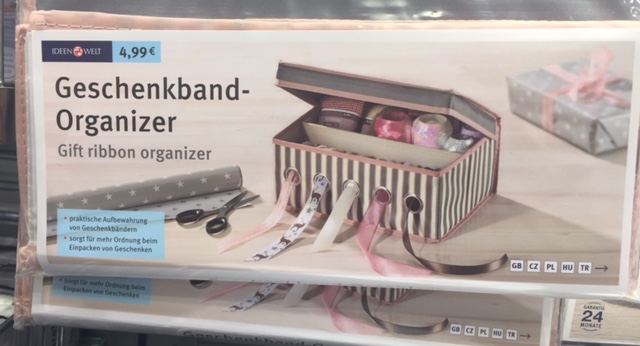
Can you think of anyone you know (with the exceptions of a German:) who would, in their right mind, even consider buying a “gift ribbon organiser”? An organiser for all those gift ribbons that would otherwise, i.e. without the organiser, just be thrown around your house. What a disaster that would be!

It made me think that life offers its own challenges to everybody.

Impairment

The greatest impairment for anybody with impairments, maybe they be caused by poverty, migration, hunger and war or by severe brain injury is not being integrated enough into community life. And guess what? – We all, each and everyone of us, all of us without exception, have the right to inclusion – according to the UN Convention of the Rights of Persons with Disabilities, a convention ratified not only by all EU member states but also by dozens of states around the world, including North Korea.

But not by Ireland.

I read a bit more on my way back to Dublin on the plane from the Prof Zieger’s brochure, published by the Hannelore Kohl Stiftung. The more I read, the more re-assured I became that we really need to bring fundamental change to Ireland in the way we treat persons with disabilities and, specifically, persons with sABI.

Here are a few more selected paragraphs written by Prof Zieger:

According to the international classification of functioning, disability and health (ICF) of the WHO, full recovery is not the only decisive criterion after a severe brain injury (impairment of physical and psychological functions). The focus of the rehabilitation process is the individual promotion of everyday activities in order to fully reintegrate someone with a severe or most severe disability and to ensure passive or active participation in community life.

According to the UN Convention on the Rights of Persons with Disabilities your loved one in coma or PVS has the right to full and preferably independent and autonomous participation in community life on a basis of equality.

You have the right to be involved and to take part in the nursing and it is also your duty to address this right with the help of the treatment team. Integration and participation are a confirmed human right regardless of the kind and severity of the disability. (…) This right also exists for long-term incubated / ventilated patients and patients who are extremely dependent on care.

Especially people with a severe injury (…) need full outpatient support, after-care and rehabilitation with participation, therapeutic assistance, pedagogical support and support from social care services.

It is important and meaningful for every individual, the family members, the surroundings, the community and the society to help people in coma or PVS actively participate in community life again. Hans are vulnerable and mortal beings depending on each other.

There is no life that is “meaningless” or “unworthy of life”. Not being integrated enough into community life is the greatest impairment for anybody may it be caused by poverty, migration, hunger and war or by severe brain injury with impaired consciousness, mobility and ability to communicate and interact with others and the environment.

Human life is dependent on a fine balance between autonomy and the feeling of belonging. Only a caring attitude towards the weaker members of society can ensure the best possible participation in community life.

Ir’s simple.

All we need is a caring attitude.

It’s the opposite to “me first”, “me great”, “me powerful”.


Trauma

Read the following.

trauma

It’s extracts from a brochure re-published by the Hannelore Kohl Stiftung written by Prof Andreas Zieger for relatives of persons with (very severe) brain injuries, persons who might still be in a coma or coma-like state.

Even people with severe injuries can recover because the brain is a social organ. The interaction with other people is essential for the patient to perceive him or himself again. (…) Only an understanding and empathetic surrounding can detect and interpret even small signs of revitalisation and recovery. These physical reaction, often first observed by relatives, can be of vital prognostic importance. (…) There are still may treating physicians who ignore them.

The experience with patients in early rehabilitation or at the coma ward has shown that loving care, consolation and support can promote early remission.

Relatives know the characteristics and the personality of the patient and often are the first ones to detect hinted movements and changes in facial expressions, breathing, heart beat, skin colour, eye opening and eye movements, It is not unusual that these early observations of little signs and primitive reactions are contradictory to the observations of the nursing staff. Some relatives have filmed the reactions to prove their observations.

All these observations indicate that coma (…) patients try to communicate with their environment earlier than previously assumed by responding in their own specific manner. The objective must therefore be to draw on these ways of expression and reaction, behavioural responses and self-actualisation and to establish a communication code through sighing, blinking, hand signals and other expressions. With your (the family/friends) presence and loving care you establish the essential trust bond and communication your loved-one needs to survive.

It has further been established that early intensive caring and communication can avoid severe forms of long-term coma or persistent vegetative state (…).

Swedish, Anlo-American and German studies have shown that as many as two-thirds of the patients can be socially reintegrated by an early and well-structured therapy programme with multi-sensory stimulation and close communication. It is especially in familiar and domestic surroundings that patients make surprising progress and become more communicable, more independent and autonomous.

The reason for staying trapped in a coma or persistent vegetative state may not only be the brain injury itself, but also additional traumas and a lack of sensory stimulation, caring, and communication.

(Prof. Andreas Zieger, Coma and vegetative state – a guide for relatives, ZNS – Hannelore Kohl Stiftung, 2015)

You might imagine what I felt when I read this.

Contrast this with the current praxis of treating persons with (very severe) acquired brain injuries. If what Prof Zieger describes has been established by researchers and practitioners, and there is no reason to doubt what he is saying, then sending people into nursing homes as a matter of course (not an exception), denying people regular and ongoing therapies, ‘managing’ their condition instead of addressing it appropriately – is neglect in my opinion.

I wonder if anyone in the professions in Ireland – from doctors to carers – is aware of what Prof Ziegler says has been established for quite some time now?

We need to make sure they are!

So that they can help us to adequately help our friends and relatives with severe Acquired Brain Injuries!

Information

Back in Tating for a day or two to get the downstairs fixed up for Pádraig. Got up too early in the morning and am too tired to write anything sensible. But had some time to read up on information for families by the Hannelore Kohl Stiftung for persons with brain injuries by a famous German professor who says all the things and more we all have been sensing to be right, and information we were never given.

Contrast that with the views expressed by professionals we met and you can immediately see the need for education.

I’ll think and dream about this tonight and look forward waking up tomorrow refreshed and full of energy.

Good night.

Urgency

There is an urgency, not necessarily shared by others, about changing how persons with severe acquired brain injury (sABI) are treated. This is not something that will be solved by a task force or a steering group planning a response to a proposal concerning the framework established …. you get my drift.

Each day that passes, sABI survivors are loosing one day of their life without the proper support. Each day that passes, family members are restricted in how they can help, by red tape, risk assessments (risk for the professionals, not the sABI survivors), and limitations imposed by ‘system’ regulations. Each day we don’t make progress in creating an alternative to the current neglect is a day lost for those magnificent young people.

Here is Pádraig holding his head up high in the bed for the hair dryer after a shower (the hand is there behind his head for ‘just in case’) and holding his leg up high in the air while sitting in his wheelchair. I tried to do both of these ‘exercises’ myself and found them both quite challenging.

Imagine that there are sABI survivors in nursing homes, nursing homes that don’t allow private, specialised physios access to sABI survivors, that don’t allow parents to do simple exercises with their family members, that don’t facilitate inclusion in appropriate social activities.

I don’t want to ramble on but we will create an alternative to these absolutely unbelievable conditions, an alternative that will allow sABI survivors and their families to live a decent without fear, without threats from anyone, and with tons of love, professional help, and a thoroughly positive outlook.

The sooner the better.

Still not heard back from the HSE, no reply to my queries and I don’t know why.

Yes we can

Just arrived back home from a half-day trip to the West. In the morning I thought I wouldn’t be able to drive because I was hardly able to walk. Which is when I decided to try it with pain killers and anti-inflammatories. They did the trick.

I managed to do a few things this afternoon and evening, all in one go.

The best of them all was my visit to Shane in Tuam and his father Joe. Joe and I had met at Croagh Patrick last year and then Joe joined us when we met with Minister Simon Harris. But I had never met Shane.

Meeting Shane was so good. I had read about his journey, his father had spoken to me about him, we had seen him on the telly – but meeting him was one of those moments in my life I will not forget. Ever. And a moment that re-enforced, if that was necessary, that we can never give up on what we started last year with the help of friends, the media, and politicians. Ever.

January is almost over and I still have not heard about a meeting date with the HSE to implement their mandate to establish the day centre An Saol proposed to them.

This needs to happen. This will happen. If it takes another campaign in February to bring home to them their obligation to do so – so it will. Although, it would be so, so infinitely better if we could celebrate a success rather than pointing our fingers to yet another failure.

Let’s put an end to failures. Let’s not tolerate ignorance, bias, sloppiness and alternative truths anymore. It’s up to us. Let’s make the health system great again. Let’s put the sick, the injured, and the most vulnerable people in our society first. Let’s return the power to the patients and their families, and take it away from dysfunctional, disjoint ‘systems’.

Can we do this? – Yes we can!

Happy

Do you ever get this feeling that you’ve had an incredibly busy day but didn’t get anything done?

I googled that question and found out that it’s quite a common problem. With simple solutions such as “cut your list of priorities” or “say ‘no’ more” or – and I really like these for their simplicity – “get website blocking” or ” scheduling apps”.

All of which might work if you work in Facebook, Google, AirBnB, LinkedIn, Twitter, eBay, SAP, Oracle or IBM.

I’ve been feeling like this for weeks now.

Partially because I spent most of my ‘free’ time, the time I did not spend with Pádraig, chasing other people who did not get back to me as they promised the would: builders, sales people, health professionals, civil servants and others.

Partially because I see less and less certainty and predictability in life – maybe that is gone forever.

Partially also – and here I will need to change – because I have to prioritise better.

Pádraig spend the afternoon with one of his sisters while we went to enjoy a wonderful Sunday lunch with friends we made when our children went to primary school – in a different world. When I got out of the car at their house I made a wrong move and hurt my back – a reminder, if that was necessary, of the need to take a little more care. Later in the evening, Pádraig had a visit from a friend who brought him a wonderful scarf from remote town in northern India where she had gone to visit a friend (who is also a friend of Pádraig’s). When I came down to the kitchen, they were sitting around the kitchen table with tea and chocolate biscuits, and Pádraig had a huge smile on his face!

happy

Happy days.

It was brilliant and beautiful to see him enjoying the chat and the laughter – and contributing to our happiness about him being there with us, taking part in his own way in the craic.

My sister in-law – no-one I know has done more hiking than her – put together an info pack for the Dingle Way / Kerry Camino and the Camino Inglés which I have started to study.

Just thinking – maybe I’m getting loads of things done but in a different way, different things, not ticking off lists, not ‘delivering’ priority stuff?

Endorphins

Haven’t been ‘running’ for a while regularly but tried to pick it up again about a week or two ago. Just short, slow, easy runs maybe twice a week for starters. Back to four runs per week from Monday. If you start listening to what researchers say about physical activity and its benefits I think I’d be mad not to keep physically fit.

It’s like reverse smoking: while you’d be mad not to quit smoking knowing about the damage it does, you’d be equally mad not to take up physical exercise knowing about the benefits it brings.

So here I am, waiting for the endorphins to kick in, after my (short!) run, out of breath and sweating like a pig.

The ‘runners high’ has officially been confirmed by the Germans (who else I ask you?), by a Dr Boecker in the University of Bonn, to be precise. According to an article in the New York Times (some time ago), the limbic and prefrontal areas are not just activated when running but also when people are involved in romantic love affairs or, Dr Boeker said, “when you hear music that gives you a chill of euphoria, like Rachmaninoff’s Piano Concerto No. 3.” The greater the euphoria the runners reported, the more endorphins in their brain.

endorphins

Unfortunately, neither today’s running nor listening to Rachmaninoff’s piano concerto no. 3 have had an effect anywhere similar to that of a romantic love affair.

I’ll keep running.

I like Saturday mornings with Pádraig. We are on our own, we have time, do what needs to be done at a very slow pace, listen to nice music, relax. I’m not a good talker or story teller, and I wish it was different because I think Pádraig would like to listen to good stories, find out what is going on, what I’m doing or thinking. But I like to think that there is communication without words, some kind or connection, unity that does not require talk.

Finally, here is a really funny 7 minute clip about Trump’s Inauguration, seen on YouTube by way more than 1 million people in just a day. Trump’s Inauguration: This Is Really Happening

Theory

There is this theory I have: look at things that work, are helpful, and create energy (and leave aside irritating, unhelpful, and paralysing stuff) and spend time with people who push positive change, are ambitious in a good way, are caring, and have high standards (avoiding people who tell you all about what is not possible, try to persuade you to accept the status quo, and have a ‘that-will-do’ attitude) then, bit by bit, life will get better because the good ‘stuff’ and the good ‘people’ will ‘outgrow’ the bad stuff and the bad people.

I think it’s a good approach to life and it helps you stay out of trouble. Focus on the good rather than taking on the bad.

Jesus would probably not have ended up on the cross had he staid out of trouble and had he not taken on the establishment.

On the other hand, would we have heard about his message of love had he not campaigned for what is right and taken on what is wrong, got into trouble?

Are there two approaches? One that keeps you out of trouble and another that lets you end up on the cross?

Do we have to choose between one and the other? Are they mutually exclusive?

Pádraig is doing well, getting a little bit better all the time, loads of exercises, good food, a bit of fresh air, happy carers. I wonder whether this is how life will continue.

North Korea

“Bitte” is the ‘magic word’ in German.

And we need some magic. While North Korea has ratified the UN Convention of the Rights of People with Disabilities, Ireland has not – remaining the only EU country not to have done so.

iu

“Bitte” is one of these words you cannot translate into English out of context. It’s actually a great German word to learn because it means so many different things that you can use it in almost any context.

It can mean “please” (when you’re asking someone for something), “you’re welcome” (as a response to “thank you”), “here you go” (when you’re handing over an item to another person), “may I help you?” (for example if you are talking to a customer), “pardon?” (when you didn’t hear or didn’t understand something), “you are not serious!”  (when someone does something he shouldn’t be doing), …

But as with every other word, there comes a time when it’s of no use because it doesn’t get you anywhere, when its purpose can’t be achieved.

That’s the time you roll up your sleeves, spit into your hands, neither look left nor right but focus on the task on hand.

This is where I am. At the beginning. Of every day.

Rosenstolz, Du bist am Leben – not one of their most famous songs, but I really like the lyrics and the rhythm that makes me think of spinning around until I get dizzy…