1.5

1.5 is the magic number, the “answer to the ultimate question of life, the universe, and everything”. And I bet you thought it was 42 – just because that number was calculated by an enormous supercomputer named Deep Thought over a period of 7.5 million years…

Pictured L-R: Cyclist Phil Skelton, Government Chief Whip and Meath East TD Regina Doherty, Fine Gael Galway East TD Ciaran Cannon

Pictured L-R: Cyclist Phil Skelton, Government Chief Whip and Meath East TD Regina Doherty, Fine Gael Galway East TD Ciaran Cannon

Well, it’s 1.5. Because it’s 1.5m euro we will need to run An Saol’s three year pilot project  And because it’s 1.5m that drivers should stay clear of bicycles when they overtake. The latter made the news today, because two TDs (or members of parliament) proposed a new law today that included a penalty for drivers who don’t keep sufficient distance from cyclists when they overtake.

The former will make headlines soon when it’ll open its doors to provide services that have never been available in the country up to now!

Pádraig had a good day today with physio, massage, and music therapy sessions (all organised by his family and friends) – except for a mishap when someone could not stop complaining and making jokes about this new law for drivers to stay clear of cyclists, until about the fifth time of asking that person to stop, making it clear that talking about this issue and, worse, in this tone was not even remotely funny in our house. Afterwards I felt like having a big full glass of something really strong, I just couldn’t believe it. I guess anything is possible, even the unthinkable.

Anyhow, I’ll be focusing on the positive, the good things. And the good people. Like the ones whose mother would have been 92 today and who have been supporting Pádraig and us like no other, never making a big fuss about it. Tonight, I’ll be thinking of this lady who would’ve been so proud of the family she raised if she was still around today to celebrate her birthday – though I’m sure she’s still with us. Good spirits stay on with us. Forever.

Phase

There must be a name for the phase I’m going through at the moment. You know, one that come after denial, anger, bargaining, depression, and acceptance. It doesn’t all end with acceptance.

phases

Like, I’ve just written yet another email to the Attorney General’s office in Boston to find out what they found out when they investigated the investigation into the accident. It’s the third time in the third year that I’m about to launch yet another campaign to establish whether the police can just issue a press release declaring someone ‘guilty’ of his own devastating brain injury within just a couple of hours of the accident on the internet because they had apparently established that the “threat” (that’s what they called Pádraig, the “threat” to the driver) just had decided to cycle into the way of that driver’s truck that was very carefully and keeping the correct distance trying to overtake him on a road that gave him sufficient space to do that safely with traffic conditions that allowed him to do this. Oh my God! I wonder, do they take all this for real themselves?

What I am doing, I am not doing in anger but out of a sense of justice that, I believe, should prevail. I am not bargaining, there is no ‘what if’… I am not depressed about what happened, life has changed for all of us, it’s not what we had planned or imagined – who would have? – but we are where we are. Which does not mean that I would have accepted what has happened in relation to the insurance or the police nor the lack of an appropriate health service. How could I? Anybody?

So what is this sixth ‘phase’?

Pádraig needs more of our efforts directed towards communication. Enabling him to communicate and enabling us to get a better grasp of how he is communicating. We’re getting pretty good with the physical side of things and he continues to make progress. Now we need to mirror that with a focus on communication.

Imagine how much he could and wants to share with us – how much his ideas and brilliant sense of humour, his at times completely over the top but very matter of fact statements only he can make, would make us all get going like nothing could ever get in our way? What would he tell us about ‘phases’? Can you imagine?

Help

We keep trying. What we can. Pádraig does and so do we.

There more I keep reading, talking to others, thinking about what is going on, so less I understand it.

We are all reasonable people. Living in a civilised society. Where the convention is that we help each other, especially when help is most needed. That is why we all agree that something has to be done about homelessness, drug addiction, refugees, single mothers (and fathers), the unemployed, the sick, the old, and the vulnerable.

We have the CRC and Enable Ireland helping people with disabilities from birth. With have support for persons with cancer, stroke, and renal illnesses.

We believe that people to whom a grave injustice has been done should receive compensation.

Now explain to me why young persons with a very severe acquired brain injury are left with just basic care.

The truth is: there is no reasonable explanation for this injustice and, how Prof Fins calls it: negligence.

I will make it my mission in life to change this. Help me!

Refugees

“By now the scene is familiar and the story predictable. An expectant family is in my office at Weill Cornell Medical College sharing the story about how a son or daughter, husband or wife, mother or father sustained a brain injury. (…)

“When they arrive, most are worn out. They are like refugees, having been cast aside by an indifferent health care system that provided brilliant emergent care only to abandon them thereafter. Irrespective of differences in race, ethnicity, class, or state or origin, a stereotype of neglect emerges. (…)

“Brains recover by biological standards, not reimbursement criteria. To impose the latter on the former is to fail take account of time frames needed for recovery by the injured brain, which as a nonlinear system resists simple predictive models. Yet that is precisely what medical necessity presupposes. It dictates the length of rehabilitation, access to brain-injury treatment programs, and other benefits. A reimbursement construct, written into federal law, medical necessity is seen by families as scripting dire outcomes. It is an affront to patients and families because it denies care notwithstanding our evolving understanding of biomarkers of the recovering brain.

“(…) Put another way, if we do not yet understand how brains recover from the MCS (minimal conscience state), and the time it might take, how could anyone say progress is delayed? Or that a patient is an inefficient outlier whose benefits should be curtailed?

“(…) Patients not “showing progress” are discharged from rehabilitation programs to nursing homes where they linger without rehabilitation or diagnostic oversight. The impact of a medical necessity determination is high, potentially depriving a patient of the opportunity to recover or, as critically, be placed in a medical context in which an emerging recovery might be identified.

“This is not a trivial problem. Recent data reveals that the diagnostic error rate of patients with traumatic brain injury in nursing homes diagnosed as vegetative may in fact be as high as 40 percent, with this patients actually being in MCS. This is troubling data and a significant error rate with profound implications. It means that a large number of patients are taken to be permanently unconscious when in fact they may be conscious, albeit in the MCS. Although there is a risk to the following speculation, I am haunted by it: imagine lying in a nursing home bed, cognitively impaired and wondering, why the staff and even your family are treating you as if you are not there. What would possibly be the reason? Don’t they care? Don’t they know I am here?

[Joseph J. Fins, Rights Come to Mind, Brain Injury, Ethics, and the Struggle for Consciousness, Cambridge University Press, 2015]

It has been a long time since I’ve read anything as important as the above.

This is the research that will drive the change that we need.

After this, no-one will be able to say that they understand our ‘personal tragedy’ but that a health system has to look at a ‘return on investment’ – thus justifying the abandonment of our loved ones, justifying un-justifiable negligence.

The above has been written by a heavy-weight: Joseph J. Fins is the E. Williams Davis Jr. M.D., Professor of Medical Ethics and Chief of the Division of Medical Ethics at Weill Cornell Medical College where he also serves as Professor of Medicine, Professor of Health Care Policy and Research, and Professor of Medicine in Psychiatry. He is the founding chair of the Ethics Committee of New York-Presbyterian Weill Cornell Medical Centre where is is an attending physician and Director of Medical Ethics. Dr Fins co-directs the Consortium for the Advanced Study of Brain Injury and is adjunct faculty member and senior attending physician at Rockefeller University and Rockefeller University Hospital. And the list goes on…

He is a someone who knows what he is talking about. – As we do.

Just in case you went through the few paragraphs above in a bit of a hurry, go back and read them again. Slowly. Then send a link to this to your friends. Especially if they work with severely brain injured persons or have a severely brain injured family member or friend.

Cake

Following a late night of partying not everybody made it to our weekly social gathering – but we had some new friends joining us today. It made a really nice and lovely afternoon in the company or great people. It was better than any Café could have been with a selection of home made and some bought but really excellent cakes and sweets, complemented by coffee, tea, herbal tea, milk and ice cold water.

Maybe we should call the whole enterprise the “An Saol Café”?! Pretty breathtaking what was shared this afternoon on those tables! Great food, great conversation, and brilliant company.

Now – spread the word and get your friends to join us next Saturday!

I had forgotten to mention that with the party last night and everything… but Pádraig had his first big long conversation yesterday with some of his friends who had come over to visit. You should have heard to shouts and laughter as Pádraig was having them on. Just using his bleeper. It was a miracle how they got all on with each other and how well they understood each other. It was pure fun. – The way it should be.

3rd Social Gathering

We will be continuing with our Saturday meetings this coming Saturday
Share your experiences with others!
Gather strength and courage!
Flavour life, literally!

The An Saol Foundation’s 3rd Saturday Social Gathering
of survivors of severe Acquired Brain Injury (sABI), their families and friends
Everybody welcome

Saturday, 18 February 2017
2pm – 5pm

Odin’s Wood HSE Day Care Centre
Kildonan Road
Finglas West
Dublin 11
Eircode: D11 H526

Enjoy an afternoon with great tea/coffee
Bring a cake, a game or an instrument
Bring yourself, friends and family
Please help us to spread the word!
http://www.ansaol.ie
Reinhard.Schaler@ansaol.ie
For enquiries: 087 – 6736414 (Reinhard)

Confirmation

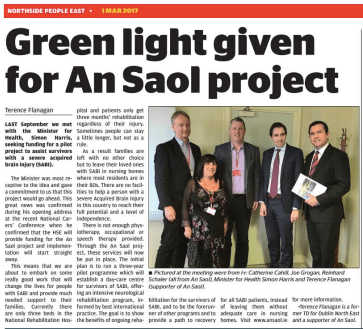
At a meeting this morning, the HSE confirmed that the An Saol Project we proposed to them will be funded and that we will start with its implementation straight away.

screen-shot-2017-02-15-at-22-05-27

About an hour later, the Irish Minister of Health, Simon Harris, T.D., confirmed this during his opening address at the National Carers’ Conference. He caught me a little bit off guard as I had not expected the announcement by him, so I lost the first few seconds of his speech. Here is what I managed to record, the Minister talking about An Saol:

I have been assured that we will receive an official letter from the HSE by the end of the week.

It’ll take a little time to sink in. But if this is all true, and there is no reason to suspect it ain’t, then we’re about to embark on some really good and exciting work here that will change the way how people think about those who have survived a very severe acquired brain injury, as well as the way they and their families are being treated by the health system.

A big thank you to all who have helped us to make this happen!

Kaputt

I am kaputt tonight. Tuesday is Pádraig’s swimming day and although I am not doing much in the pool it makes me sooo tired. It’s the biggest pool ever. The biggest. Really. Unbelievable. But it’s true. It’s true. Believe me. (I don’t like admitting to this but I have this voice in my head and it doesn’t go away…)

kaputt

But the tiredness was blown away but what happened in the pool today. For the first time ever, Pádraig pushed himself up and stood on his feet, with just some support. Not for very long. But that’s what he did. He also moved his feet through the water, like walking. As if that hadn’t been enough, he held on to the bar on the pool side, pulled himself in and pushed himself out – several times.

Really, this was one of the best days in a long time and one of the most amazing things Pádraig has done. There’s no pictures of any of this, no pictures allowed, so you have to use your imagination. It was pure magic.

Of course, today is Valentine’s Day. And guess what? – I got hyacinths. In a pot. Ok, it’s not roses. But hyacinths ain’t bad either.

All in all: a St Valentine’s happy day!

Family

First of all, let’s park that romantic notion of family: all understanding, all loving, all civilised, all friends, all the time. I’m honest: there are things I’ve said to my families, both the one I was born into and the one I co-founded, I’d never have said to anyone else, on both ends of the scale. There is behaviour my families have experienced I have never shown to anyone else – and I’d prefer nobody else to know about. On both ends of the scale. I don’t want to presume anything here. But I don’t think I’m on my own here?

The first time I left home for a year abroad, I felt so abandoned, so alone, that I wondered how I would ever survive this year without being able to share what was going on in my life with my family. Not that I wanted them to know about everything that I was doing, but I missed their encouragement, their understanding, maybe just their attention.

Even though my ‘first’ family is getting smaller, it hardly exists anymore, and even though my role in my ‘second’ family is very different (I’m supposed to be the one listening:), I still feel there is anyone better, more understanding, more patient, more encouraging, than the members of my family. If anything happens, no matter whether it’s a cause for celebration or cause for tears, the are the ones I want to know first. And if I really need help, I know they’ll be there for me.

That first years abroad I mentioned earlier changed my whole life around in different ways. I had the deepest conversations ever with people I had never met before and didn’t meet since. They told me things they had never told anyone before, and so did I. One of the lessons I learned from these conversations was that the most opposite of feelings never exist on their own. They (almost) always come together. To feel strongly about something or someone, they must be important to you. You’d never love, nor relate in a really negative way to a complete stranger – they wouldn’t be worth these intensive feelings. It takes someone really close to you to experience the whole range of feelings. And to learn that love will always win, if you let it.

Pádraig had a good day. Getting ready for and looking forward to tomorrow’s swimming session!

Check out today’s The Herald Newspaper with two articles about the need for better NeuroRehab in Ireland.

2017-02-13-19-46-herald

2017-02-13-22-03-herald-editorial

http://www.herald.ie/news/we-jumped-on-a-plane-rather-than-wait-for-care-35444931.html
http://www.herald.ie/news/we-have-56-beds-in-neuro-rehab-but-we-really-need-280-35444928.html