• About
  • Proud

Hospi-Tales

~ Acquired Brain Injury (ABI): from the acute hospital to early rehabilitation – more on: www.CaringforPadraig.org and www.ansaol.ie

Hospi-Tales

Category Archives: Uncategorized

Everybody knows

03 Friday Feb 2017

Posted by ReinhardSchaler in Uncategorized

≈ Leave a comment

I have been wondering much about repeating myself. I’ve been wondering about the purpose of writing this blog when I’ve said what is to be said, when people in large organisations are using it to exercise control and wield their power.

There isn’t much more to say then I’ve said about this journey from the acute hospital to early neuro rehabilitation and onwards to residential and home care. Maybe it’s time to distill this journey into the essence of it all and write that book.

everybody-knows

One thing I haven’t written about is how a little part inside of me dies each time I hear another, new shocking detail about the infuriating lack of care; or the inexplicable underuse of publicly funded equipment; or the lack of response to cries for help; or the nonchalant transfer to a nursing home of a perfectly alive young person; or the lack of education, training, and experience amongst the people in charge of caring and treating our loved ones; or blatant threats to families by health professionals; or the incredible lack of urgency to address life and death issues; or the disenfranchisement and incapacitation of survivors and their families.

But by writing about it, by repeating stuff everybody who wants to know knows already – will anything change?

Everybody knows that the dice are loaded
Everybody rolls with their fingers crossed
Everybody knows the war is over
Everybody knows the good guys lost
Everybody knows the fight was fixed
The poor stay poor, the rich get rich
That’s how it goes
Everybody knows


Invitation

02 Thursday Feb 2017

Posted by ReinhardSchaler in Uncategorized

≈ Leave a comment

Enjoy an afternoon with great tea/coffee,
even better home-made cakes,
and the best of Irish Music
Share your experiences with others!
Gather strength and courage!
Flavour life, literally!

The An Saol Foundation’s First Social Gathering

of survivors of severe Acquired Brain Injury (sABI), 

their families and friends

Everybody welcome

Saturday, 04 February 2017
2pm – 5pm

Odin’s Wood HSE Day Care Centre
Kildonan Road
Finglas West
Dublin 11
Eircode: D11 H526

Please help us to spread the word!
http://www.AnSaol.ie
Reinhard.Schaler@ansaol.ie
For enquiries: 087 – 6736414 (Reinhard)

Moments

01 Wednesday Feb 2017

Posted by ReinhardSchaler in Uncategorized

≈ Leave a comment

Have you ever sat on a bus, looking of the window, and all of a sudden, the world revealed itself to you, everything made perfect sense — and then it all vanished as quickly as it came to you, you are desperately trying to remember what it was, but it’s gone.

moments

One of Pádraig’s friends was telling us about a day when Pádraig had one of those moments (on the bus:) and as we were talking, we were wondering if these are the moments of happiness you remember. (We were also wondering whether Pádraig had made the whole story up just to have a bit of fun.)

Does happiness come to you when you least expect it? Can it come to you when you are ‘down and out’? Does it come in short flashes, in moments?

Just found a new German song (new for me) by Sebastian Hackel, Warum sie lacht. Not bad if you can ignore his hair do:)

Und das Leben ist schön,
die Zukunft ist dran,
die Sonne scheint,
ich weiß, dass ich lachen kann,
ich geh an, was ich angehen kann.

Und ich mach Seifenblasen,
Welten spiegeln sich,
und zerplatzen aus dem Nichts.

Today is the first day of spring in Ireland, lá Fhéile Bride. The end of winter. The beginning of new life.

Successful

31 Tuesday Jan 2017

Posted by ReinhardSchaler in Uncategorized

≈ Leave a comment

It was one of the loveliest mornings, followed by a great afternoon.

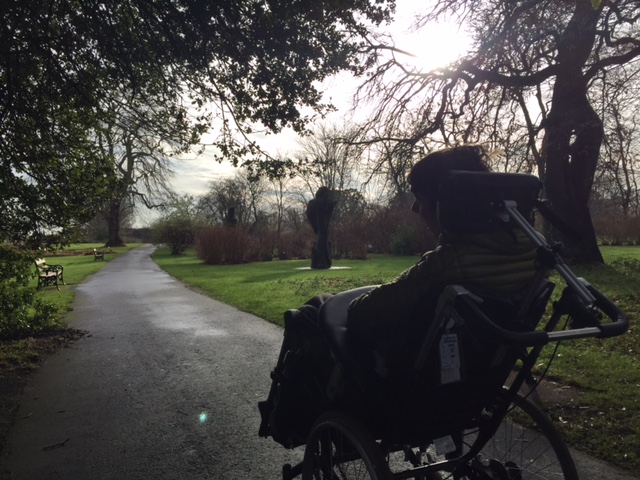
When the rain stopped this morning, Pádraig and I went for a walk into the Botanic Gardens. We walked slowly, stopped, looked, smelled, felt, listened. It came to a point where I was wondering what we are doing inside, sheltered from anything close to nature, with artificial lights, rapped in noise coming out of the aether, with spring scent being sprayed out of a Johnson & Johnson bottle, and food produced in a factory.

img_6707

The problem is: nature doesn’t sell, doesn’t create employment, doesn’t generate wealth, doesn’t bring success. It’ll most likely disappear and the Yellow Taxi will drive you by a parking lot where once there were trees, now being kept in a tree museum.

We’re forgetting about the important things. We don’t know what we’ve got ’til is gone, Joni Mitchell would say.

Pádraig checked out a different swimming pool today. During a public swimming hour. We didn’t have to arrange anything special for him. The pool was the Enable Ireland pool in Sandymount, but it was public swimming and there were plenty of other people in the pool with him. No stretcher to get him into the water, just a shower chair kind of seat. First I thought that this would be difficult, but it wasn’t difficult at all. In the end I thought, maybe it’s a good job that there wasn’t a stretcher but just a chair. It was great to see and it must have felt great for him to see that he could manage in the chair.

Found a great quote by Mark Twain that made me think: “All you need in this life is ignorance and confidence, and then success is sure.”


GetTogether

30 Monday Jan 2017

Posted by ReinhardSchaler in Uncategorized

≈ Leave a comment

This coming Saturday, 04 February, 2-5 pm, we will have a get-together with survivors of a severe acquired brain injury (sABI), their families and friends in the HSE Day Care Centre in Odin’s Wood:

HSE Odins Wood Day Care Centre for Older Persons
Kildonan Road
Finglas West
Dublin11
Ph 8142505

Some friends and volunteers have come forward and are organising cakes, others are getting some friends together to play a bit of music.

The idea is to establish a regular meeting place for sABI survivors and their family and friends where we can meet, chat, exchange ideas and provide support for each other.

Everybody is welcome! – Please spread he word!


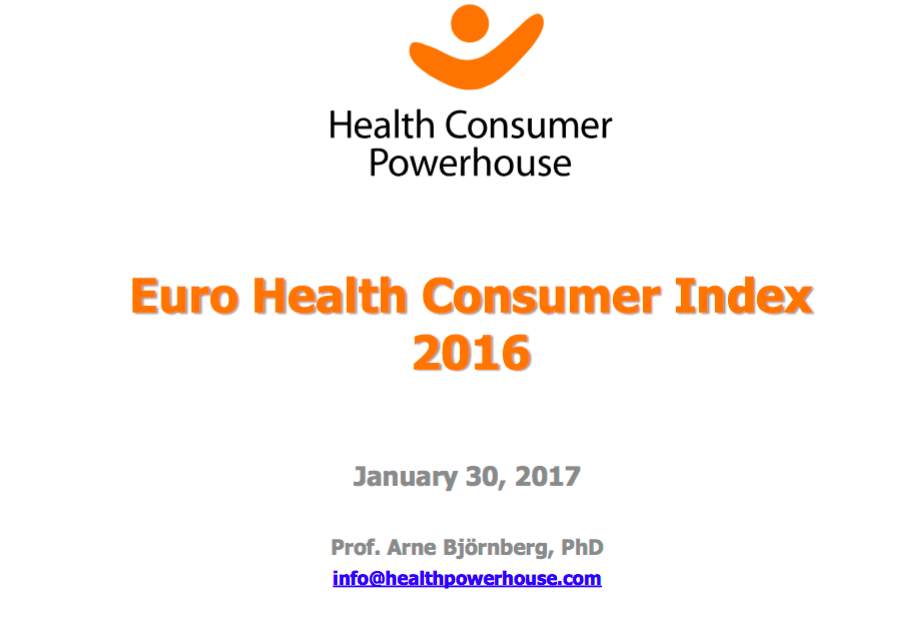
You might have heard that today the latest European Health Consumer Index (2016) was published, ranking 35 countries against a variety of criteria. The report presents some interesting and some already well-known findings. The good thing is: you can download it for free here.

screen-shot-2017-01-30-at-18-33-13

There is also a presentation available for free summarising the results.

According to the report, Ireland is having poor emergency department waiting times and ranks poorly in terms of the right to a second opinion, access to online booking of appointments, direct access to a consultant, getting a planned operation within 90 days and the equity of the health system.

Prof Björnberg said this morning on RTÉ that even if Ireland achieved its target to minimise waiting times for specialist’ appointments to 18 months this would still be the worst amongst all countries currently being considered.

According to the report, Ireland ranks well in terms of the decrease in cardiovascular disease deaths, decrease in deaths from strokes, infant deaths and better cancer survival; it also scores well with regard to access to medicines.

Pádraig is continuing to improve. This lunch time, while doing exercises with one of his PAs, sitting in his wheelchair, he managed to keep one leg up in the air and, at the same time, moving the other leg up and down. – Can you imagine how much more fun, how much more beneficial, and how much better it would be to do these exercises in a group where we could encourage one another?

The meeting next Saturday will be a start to get some social activities going. The NeuroGym and our own Day Care Centre will follow! (Still no word from the HSE with a date for a planning meeting….)


Expert

29 Sunday Jan 2017

Posted by ReinhardSchaler in Uncategorized

≈ Leave a comment

It’s not as if I didn’t want to or couldn’t write myself anymore. But after years of writing about what has been happening to Pádraig. After years of despair. After years of wondering how those responsible could sleep at night. After years of wondering: what is it that I have to do to get people’s attention so that we can not just agree to but act to end this horrific injustice that is leaving behind our loved ones with severe acquired brain injury. I have found experts supporting what I have been trying to say. Doing to our loved ones what the health system is doing is not just negligence but it is a grave violation of their human rights – in the full knowledge of what recent research, as well as personal experience, has been telling us about how sABI survivors should be treated.

Here is an extract from an article by… wait!

Joseph J. Fins
The E. William Davis, Jr., M.D. Professor of Medical Ethics and Professor of Medicine, Chief Division of Medical Ethics Weill Cornell Medicine and Solomon Center Distinguished Scholar in Medicine, Bioethics and the Law, Yale Law School, Cornell University

“In the end, the vast majority are placed in a nursing home or institution, which is euphemistically called “custodial care.” Fewer than 15 percent of people with moderate to severe TBI get in-patient rehabilitation.

“For years, we thought this was the end of the story. These patients were deprived of skilled and sustained rehabilitation because we thought there was no hope.

“But in the last decade, neuroscience has made great breakthroughs in our understanding of the brain and its resilience. With proper and state-of-the-art rehabilitation, 21 percent of the most grievously injured can achieve functional independence. That might not seem like a big number, but no one would have predicted this when these people rolled into the emergency room. But with devoted care and sustained rehabilitation, this level of recovery was achieved.

“One of the most distressing realizations has been that many patients who are thought to be permanently unconscious or vegetative – and thus ignored and neglected – are in fact conscious and aware. In fact, one study found that two out of every five patients in nursing homes who have a traumatic brain injury and are thought to be vegetative were actually conscious when carefully assessed. It is a staggering error rate, which would be unthinkable if we were talking about making a credible diagnosis of heart disease or cancer.

“What does it mean to write these people off? What does it mean to mark a patient as permanently unconscious when he is in fact aware and in the room? Imagine what it must be like to lie in a nursing home bed and be ignored as if you weren’t there, estranged from your family and the broader human community. Could anything be more isolating?

“It suggests we cannot think of this as simply a health care financing question, but something deeper and more fundamental. To me, it’s a civil rights issue and one that gets to the core of whom we value and who counts.”

I have been trying to explain the above to politicians, to health professionals, and to the media. – Is anybody listening? Is anybody actually doing something about this? Can you believe that our one and only traumatic brain injury rehab centre in Ireland does not have even a simple EEG – never mind the sophisticated equipment Prof Fins is referring to? That there is not one neurologist working in this field? That there are three beds – not to treat but to diagnose the injuries sustained by sABI survivors? That their treatment is confined to three months and that they are then discharged with no, absolutely NO recommendation as to the therapy required by them?

I have been told to be reasonable. I have been told to be calm. I have been told not to make this personal. I have been told not to name anyone in this blog.  That’s because we are all civilised and we want to work together to help Pádraig and others like him.

When is that help coming?

There are huge resources available. But they are either under-used or wasted in many ways. We need access to these resources. Now.
fullsizerender

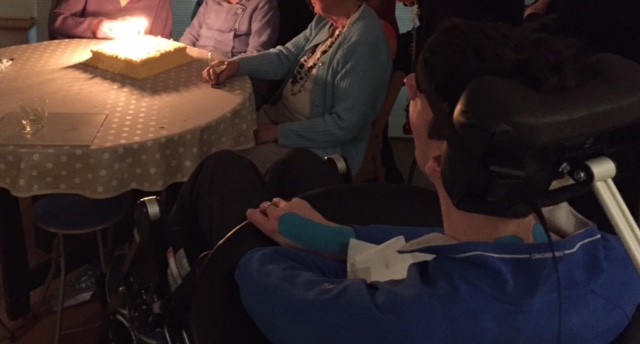
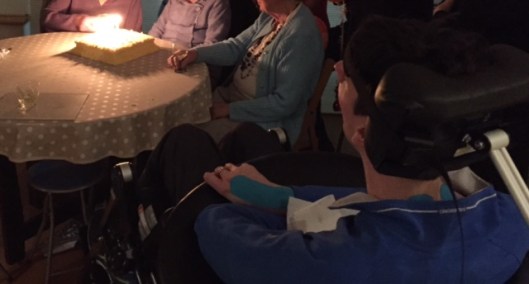
Pádraig had two of his good friends visiting him today. It was lovely. Relaxed. With really good conversation and communication going on. Later on in the afternoon and evening, one of his grand aunts celebrated her 90th birthday and he joined the party with the rest of the family. I am writing this because this is not what the health system had in mind for him. This is not what health professionals expected when they told us that they were surprised that the surgeons operated on him after the accident (keep in mind that this was a life-saving operation); when they were wondering speaking to us whether it wouldn’t have been better had he died (at his bedside, with him understanding every word); when they said on national radio that scarce resources couldn’t be wasted on severely injured like him.

But there he was again today, sailing the Dreamboat up the stream. Celebrating life. An Saol!

PS: Thank you to one of Pádraig’s friends who sent me a link to the article by Prof Fins!

Traveller

28 Saturday Jan 2017

Posted by ReinhardSchaler in Uncategorized

≈ 5 Comments

If you are a traveller between cultures, space, time, and language, then you must be familiar with what happens to me, almost every time, when I travel from one home to the other. You see things, people, and behaviour that is so familiar to those who never managed to have a look from the outside to the inside that they won’t ever see what you are seeing.

organizer

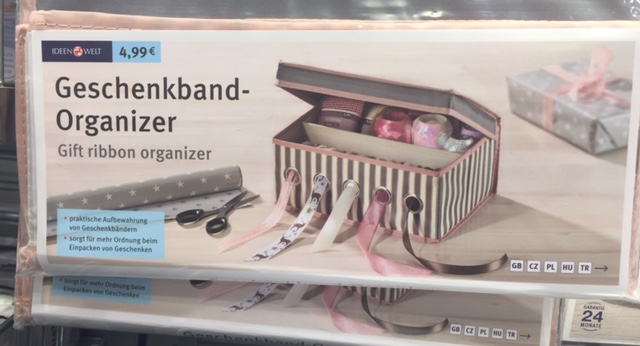
Can you think of anyone you know (with the exceptions of a German:) who would, in their right mind, even consider buying a “gift ribbon organiser”? An organiser for all those gift ribbons that would otherwise, i.e. without the organiser, just be thrown around your house. What a disaster that would be!

It made me think that life offers its own challenges to everybody.

Impairment

28 Saturday Jan 2017

Posted by ReinhardSchaler in Uncategorized

≈ Leave a comment

The greatest impairment for anybody with impairments, maybe they be caused by poverty, migration, hunger and war or by severe brain injury is not being integrated enough into community life. And guess what? – We all, each and everyone of us, all of us without exception, have the right to inclusion – according to the UN Convention of the Rights of Persons with Disabilities, a convention ratified not only by all EU member states but also by dozens of states around the world, including North Korea.

But not by Ireland.

I read a bit more on my way back to Dublin on the plane from the Prof Zieger’s brochure, published by the Hannelore Kohl Stiftung. The more I read, the more re-assured I became that we really need to bring fundamental change to Ireland in the way we treat persons with disabilities and, specifically, persons with sABI.

Here are a few more selected paragraphs written by Prof Zieger:

According to the international classification of functioning, disability and health (ICF) of the WHO, full recovery is not the only decisive criterion after a severe brain injury (impairment of physical and psychological functions). The focus of the rehabilitation process is the individual promotion of everyday activities in order to fully reintegrate someone with a severe or most severe disability and to ensure passive or active participation in community life.

According to the UN Convention on the Rights of Persons with Disabilities your loved one in coma or PVS has the right to full and preferably independent and autonomous participation in community life on a basis of equality.

You have the right to be involved and to take part in the nursing and it is also your duty to address this right with the help of the treatment team. Integration and participation are a confirmed human right regardless of the kind and severity of the disability. (…) This right also exists for long-term incubated / ventilated patients and patients who are extremely dependent on care.

Especially people with a severe injury (…) need full outpatient support, after-care and rehabilitation with participation, therapeutic assistance, pedagogical support and support from social care services.

It is important and meaningful for every individual, the family members, the surroundings, the community and the society to help people in coma or PVS actively participate in community life again. Hans are vulnerable and mortal beings depending on each other.

There is no life that is “meaningless” or “unworthy of life”. Not being integrated enough into community life is the greatest impairment for anybody may it be caused by poverty, migration, hunger and war or by severe brain injury with impaired consciousness, mobility and ability to communicate and interact with others and the environment.

Human life is dependent on a fine balance between autonomy and the feeling of belonging. Only a caring attitude towards the weaker members of society can ensure the best possible participation in community life.

Ir’s simple.

All we need is a caring attitude.

It’s the opposite to “me first”, “me great”, “me powerful”.


Trauma

26 Thursday Jan 2017

Posted by ReinhardSchaler in Uncategorized

≈ Leave a comment

Read the following.

trauma

It’s extracts from a brochure re-published by the Hannelore Kohl Stiftung written by Prof Andreas Zieger for relatives of persons with (very severe) brain injuries, persons who might still be in a coma or coma-like state.

Even people with severe injuries can recover because the brain is a social organ. The interaction with other people is essential for the patient to perceive him or himself again. (…) Only an understanding and empathetic surrounding can detect and interpret even small signs of revitalisation and recovery. These physical reaction, often first observed by relatives, can be of vital prognostic importance. (…) There are still may treating physicians who ignore them.

The experience with patients in early rehabilitation or at the coma ward has shown that loving care, consolation and support can promote early remission.

Relatives know the characteristics and the personality of the patient and often are the first ones to detect hinted movements and changes in facial expressions, breathing, heart beat, skin colour, eye opening and eye movements, It is not unusual that these early observations of little signs and primitive reactions are contradictory to the observations of the nursing staff. Some relatives have filmed the reactions to prove their observations.

All these observations indicate that coma (…) patients try to communicate with their environment earlier than previously assumed by responding in their own specific manner. The objective must therefore be to draw on these ways of expression and reaction, behavioural responses and self-actualisation and to establish a communication code through sighing, blinking, hand signals and other expressions. With your (the family/friends) presence and loving care you establish the essential trust bond and communication your loved-one needs to survive.

It has further been established that early intensive caring and communication can avoid severe forms of long-term coma or persistent vegetative state (…).

Swedish, Anlo-American and German studies have shown that as many as two-thirds of the patients can be socially reintegrated by an early and well-structured therapy programme with multi-sensory stimulation and close communication. It is especially in familiar and domestic surroundings that patients make surprising progress and become more communicable, more independent and autonomous.

The reason for staying trapped in a coma or persistent vegetative state may not only be the brain injury itself, but also additional traumas and a lack of sensory stimulation, caring, and communication.

(Prof. Andreas Zieger, Coma and vegetative state – a guide for relatives, ZNS – Hannelore Kohl Stiftung, 2015)

You might imagine what I felt when I read this.

Contrast this with the current praxis of treating persons with (very severe) acquired brain injuries. If what Prof Zieger describes has been established by researchers and practitioners, and there is no reason to doubt what he is saying, then sending people into nursing homes as a matter of course (not an exception), denying people regular and ongoing therapies, ‘managing’ their condition instead of addressing it appropriately – is neglect in my opinion.

I wonder if anyone in the professions in Ireland – from doctors to carers – is aware of what Prof Ziegler says has been established for quite some time now?

We need to make sure they are!

So that they can help us to adequately help our friends and relatives with severe Acquired Brain Injuries!

Information

25 Wednesday Jan 2017

Posted by ReinhardSchaler in Uncategorized

≈ Leave a comment

Back in Tating for a day or two to get the downstairs fixed up for Pádraig. Got up too early in the morning and am too tired to write anything sensible. But had some time to read up on information for families by the Hannelore Kohl Stiftung for persons with brain injuries by a famous German professor who says all the things and more we all have been sensing to be right, and information we were never given.

Contrast that with the views expressed by professionals we met and you can immediately see the need for education.

I’ll think and dream about this tonight and look forward waking up tomorrow refreshed and full of energy.

Good night.

← Older posts
Newer posts →

Enter your email address to follow this blog and receive notifications of new posts by email.

Join 414 other subscribers
blog awards ireland

Blog at WordPress.com.

  • Subscribe Subscribed
    • Hospi-Tales
    • Join 240 other subscribers
    • Already have a WordPress.com account? Log in now.
    • Hospi-Tales
    • Subscribe Subscribed
    • Sign up
    • Log in
    • Report this content
    • View site in Reader
    • Manage subscriptions
    • Collapse this bar
 

Loading Comments...