
The boys are back in town. It’s great to see them again, and I’m sure Pádraig was really happy to see them and to hear their voices. We caught up on loads of things, heard how everyone was, and got an update on the Dreamboat. (Can’t wait for it!)
When we were leaving the hospital and we got talking, we stumbled upon some essential questions, touching the heart and soul of what it means to be German.
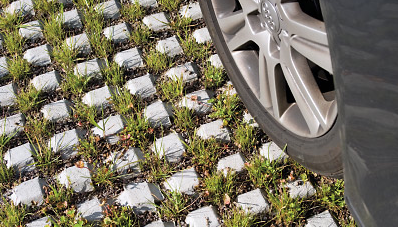
Have you ever wondered what this is?
The first questions is one many visitors have asked before – and I don’t think I ever gave them a proper answer. What they were wondering was why on earth had the engineers who built the Schön-Klinik decided to put down those concrete ‘stones’, paving that is not really paving because you would probably break you ankle if you tried to walk on it. – Tonight, I will lift the vail of mystery: the mysterious structure is called “Uferstein”. Here is what one major supplier has to say about “Ufersteine”:
“Ufersteine werden in Randzonen von stehenden oder fließenden Gewässern zur Vermeidung von Ausschwemmungen oder Ausuferungen eingesetzt. Auch der Einbau in Anböschungen und stärker belasteten Verkehrsflächen, z. B. Feuerwehreinfahrten, ist üblich.”
Oh – you don’t speak German? Don’t worry. I don’t really understand myself what this means either. And I still don’t understand why they don’t just use “Rasengittersteine”. Wouldn’t you agree?
The second question was really touching the core of what it means to be German.
To really appreciate this you must know the following (source: http://www.tagesschau.de/inland/fleisch104.html):
“Vier ganze Rinder, vier Schafe, zwölf Gänse, 37 Enten, 46 Schweine, 46 Puten und 945 Hühner – im Laufe seines Lebens verzehrt ein Deutscher laut “Fleischatlas 2013″ durchschnittlich 1097 Tiere.”
Oh, you don’t speak German? But this time, you must have guessed what the above says!? The quote is from the German ‘meat atlas’ and it says that, on average, each German eats per year 1,097 animals. Would you believe it!? Four entire cattle, four sheep, 12 geese, 37 ducks, 46 pigs (that is almost an entire pig a week!!!), 46 turkeys, and an unbelievable, incredible 945 chicken! It’s almost three animals a day, 3 in 1 (one) day!!!
 Back to the original question from the lads. They wanted to know why a German sausage or “Bratwurst” could not be sold like a ‘hot dog’. Not sure whether you are as surprised as I was when they asked that question? I mean, come on, even the thought of comparing a ‘hot dog’ with a German Bratwurst… I mean, if you allow that comparison, where will it all end? Next time they’ll probably question why we use “Ufersteine” instead of straight forward asphalt!
Now seriously, what they were wondering was: why is the bread roll so short and the Bratwurst so long? – In my mind I was thinking (though I didn’t tell them) that they should be grateful to get a long bratwurst and not a short hot dog. Here in Germany, the customer is still king. What I told them instead was that they could, if they were on their own, and since the bread roll was wider than the sausage, that they could double up the sausage to fill the entire bread roll; and, if they were with someone else, they could break the Bratwurst into two pieces and each eat half of the Bratwurst together with half of the bread roll, dividing it into upper and lower halfs. The only problem in such cases that I have encountered is the discussion about who will get the upper and who will get the lower half of the bread roll. (The top is crispier than the bottom.)
If you managed to read through all of the above you probably think that I have finally lost my mind. – Rest assured, I haven’t. Yet:)
Another day of action, really, in the hospital today. The dentist was back to check Pádraig’s tooth guard and teeth, and decided that while both showed some degree of damage, it was not bad enough to require his intervention. Pádraig was also visited by surgeons who fixed the nails of both of his big toes which had caused him small local on/off infections for weeks if not months by now. A nurse proposed to get a hairdresser in (she meant to say a ‘barber’) to cut Pádraig’s hair in order to make it easier to ‘wash’ it with their chemical ‘shower cap’-like hair-cleaning method. – I think we’ll cut it ourselves and then try out the head-bath we got to wash his hair.
It was great to see so many good things all happening over the past two days, some of the issues that were dealt with in the space of just two days were issues about which we had asked questions for months. It’s like as if someone had flipped a switch and the magic started to happen… Just shows you that you need keep asking questions.
We’ll keep the questions going. No question is ever a stupid question – whether it’s about personal hygiene, German sausages, or ‘Ufersteine’. Wouldn’t you agree?
 Hospi-Tales
I guess, Reinhard, that these Ufersteine are supposed to keep you from wading ankle-deep through the mud and maybe preventing landslides. Who knows.
Well, I hope we are not so voracious as to eat 1097 animals per year but in a lifetime as the quote says. Although I must admit there are people who look as if they had almost an entire pig a week.
Yes, Gisela – these Ufersteine are especially important beside the hospital, they wouldn’t have put them there otherwise. – As to the amount of animals we eat, it was a test to see who would react, and really *read* this:) You are, of course, right, it would be impossible (even for a German:) to eat that many animals in a year – although, as you say, if the life expectancy at birth for Germany is 80 years, than that is still close to 14 entire animals a year, including more than half a pig and a dozen entire chicken. Not bad. And that is the *average*:)
Reinhard, how could you think we would not read each single post carefully. They are always an enjoyment in the morning unless there is a problem with Padraig. By the way, I really love the idioms in our Ruhr Valley dialect. It is surprising you have not forgotten them.
There’s two secrets I’ll have to tell you, Gisela: (1) It was really late when I wrote this blog entry about the meat and the Germans (and you know the rest:); (2) I do remember some of the Ruhrpott words and have started to use them here again, they work wonders in Hamburg, but I also look stuff up, occasionally. I know, it’s all a bit embarrassing (which is why I’ve kept it a secret:).