
Martin Niemöller (1892-1984) was a protestant pastor and social activist. In a speech/poem from 1946, he points out that when you see injustice done you better do something – even if that injustice does not affect you (yet). Because if you don’t, there will be nobody left to help you when you need help. Fighting injustice is a moral and ethical obligation. (See below for the full quote by Niemöller.)
“We can’t judge the past” said the speaker for the dioceses yesterday when he was interviewed by RTÉ News just beside the field in Tuam where two boys, playing, had lifted the slab covering a disused septic tank. What they discovered was horrific: the tiny bones and skulls of nearly 800 infants between 2 days and 4 years old, stacked up 9 feet deep in the tank.
Donal O’Keeffe reports in today’s thejournal.ie how Father Flanagan – yes, THE Father Flanagan – told a public meeting in Cork’s Savoy Cinema in 1946 (the same year Niemöller wrote his speech/poem): “You are the people who permit your children and the children of your communities to go into these institutions of punishment. You can do something about it”; he called Ireland’s institutions “a disgrace to the nation”. O’Keeffe also reports how the then Minister of Justice, Gerald Boland, reacted in the Dail to Father Flanagan’s call for action. The Minister said, “I was not disposed to take any notice of what Monsignor Flanagan said while he was in this country, because his statements were so exaggerated that I did not think people would attach any importance to them.”
I do think (and maybe it’s the German in me) that we can judge the past.
Forógra na Poblachta, the Proclamation of the Irish Republic from 1916, gave a promise to cherish “all the children of the nation equally”.
When our sons and daughters look back and ask us what we did to afford the right to proper and timely health care to people with severe acquired brain injury, what we did to assure that they were equally cherished and treated with dignity – we should be able to say “all that we could”.
Pádraig was well today. He cycled his 3km Giro d’Schön and was in good form, considering the circumstances.
His story seems to get quite a bit of visibility on Facebook. One of his friends in Kentucky, USA, sent us an email to say that a friend of hers, interested in Ireland and stories from Ireland, had received a FB recommendation to read this blog… Another person who became really interested is the owner of an Irish Pub in Hamburg, Paddy’s, who we look forward to meet some day soon. He is organising a fundraiser for Caring for Padraig.
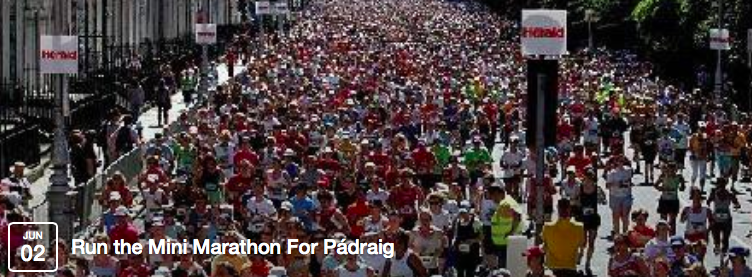
Which brings me to next Monday and Saturday: Monday will see a large number of women, ‘drag queens’ and other ‘shady characters’ running what’s called, completely inappropriately – I’m sure you’d agree, a “marathon”. I ask you, who’d ever heard of a ‘women’s marathon’, and one of 10km??? The poor auld Greeks who ran the ‘marathon’ must turn in their graves!!! I would have love to be there, just for the fun of it! – PLEASE support the runners! Never mind whether it’s runners, walkers, women, or wanna-bees! They’re all great! Check it out here.
Finally, also check out the Mountain Flag Challenge! If you never put your flag up on top of a mountain – this is your chance!!! This day week, friends or mine will face the Mountain Flag Challenge for Pádraig. Join them and check out the details here.

By Martin Niemöller
Als die Nazis die Kommunisten holten,
habe ich geschwiegen;
ich war ja kein Kommunist.
Als sie die Sozialdemokraten einsperrten,
habe ich geschwiegen;
ich war ja kein Sozialdemokrat.
Als sie die Gewerkschafter holten,
habe ich nicht protestiert;
ich war ja kein Gewerkschafter.
Als sie die Juden holten,
habe ich geschwiegen;
ich war ja kein Jude.
Als sie mich holten,
gab es keinen mehr,
der protestieren konnte.
When the Nazis came for the communists,
I remained silent;
I was not a communist.
When they locked up the social democrats,
I remained silent;
I was not a social democrat.
When they came for the trade unionists,
I did not speak out;
I was not a trade unionist.
When they came for the Jews,
I remained silent;
I wasn’t a Jew.
When they came for me,
there was no one left to speak out.
 Hospi-Tales
Hey, I knew that poem but I had forgotten who had written it!!! very weill explained, we have to fight injustice because it is a moral thing to do.
Yes, Ana, it is a moral and ethical obligation. It’s also self-preserving – a ‘bad’ system will eventually get you too, even if it might not affect you at the moment.
Hello, Reinhard. I knew about the Mini-Marathon but not about the Mountain Flag challenge. Good to be kept in touch like this. Thank you. With best wishes, Louise.
It’s organised around the Localization World Conference that will take place next week in the Dublin convention centre (www.localizationworld.com) – it’s one of the larger events in localisation and travels around the world. The organisers of the conference and many participants are good old friends.
I love that Poem Reinhard! I often recite it when I’m trying to convince apathetic people to take action/ sign whatever petition I’m pushing 🙂 I didn’t know anything about the author before now or that it was originally in German. Thanks for sharing! Sorcha.
Isn’t it unbelievable how convincing it is, Sorcha? And so ‘obvious’ and timeless? Niemöller was involved in War Resisters International where I heard of him first via its German branch. There is a wikipedia article about him which you might have found in the meantime…
Thank you, I should also mention that Pádraig never needed much convincing to sign whatever letter or petition myself and the Amnesty society had running in the Arts block. He may have taken the literature to read for a while and form an opinion but he always signed 🙂
A moving piece, Reinhard. I continue to be inspired by you and your blog.
It’s the other way around, Veronica. I would never have found the strength to continue without friends and family.