
Today we took a walk, on the wild side, as it turned out. In the red zone. We were exploring our neighborhood, and trying to get out of all of these restricted spaces we have (not) been moving in lately: ICUs, Picanto, apartment.
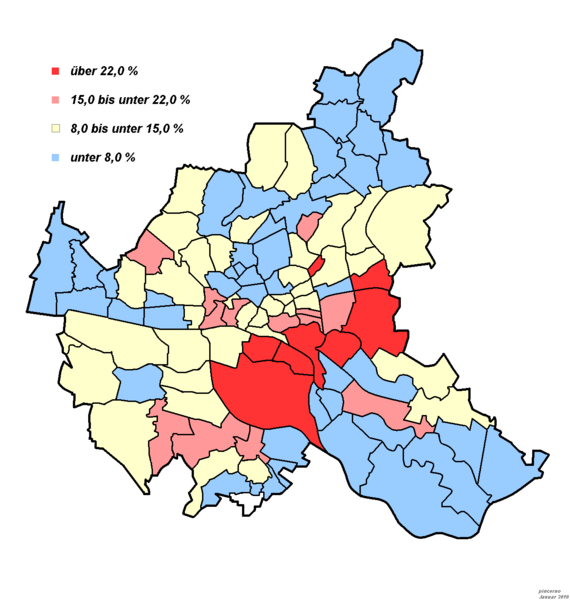
Dulsberg – the tiny red zone in the middle of the map, surrounded but affluent yellow.
Hamburg is one of the richest and biggest cities in Germany. So rich that the local newspaper reported in July of last year: ‘Hamburg to expensive for average income earners‘. A study found that rent in Hamburg is only affordable to just about 11% of the average income earners. Many people had to move out of the city (sounds familiar?). The average distance between the city and where people live is 27km in Hamburg, just 8km on average in Germany – which is about the distance between O’Connell Bridge and Santry in Dublin.
When I was looking for the apartment, I got a taste of that: viewings were always overcrowded, the auctioneers got stacks of ‘applications’ (with interested parties supplying all of their personal and financial details), and the rent they were asking for was, I thought, astronomical. So, when I found this 50m2 apartment in Hamburg-Dulsberg, less than 10 minutes walk from the Schön-Klinik in Eilbek, for rent not by a private landlord, but by a Wohnungsgenossenschaft (remember the ‘Genossenschaft’?), and for less than 600 euro (‘warm’), I did all I could to get on top of their list, and was over the moon when I got the ‘ok’.

Chalets and plots – for people living in apartments, right beside busy main roads.
I didn’t know then, what I learned from the newspaper the other day: that Dulsberg is in the ‘red zone’, marking a part of Hamburg which, in a sea of more affluent parts, is home to the highest number of ‘Leistungsempfänger’ in the city. When we took our walk on the wild side today, we saw what that meant here: loads of offices for getting help, a huge amount of creches with marvelous playgrounds, and little garden-parks (plots) besides busy streets. And – when we went into a ‘Bäckerei’ (run by an Asian fellow citizen) to buy one Bavarian ‘Brezel’, he charged us 85 cent for one Brezel, but put two into the bag. That’s would good neighbours are all about!
Pádraig was keeping up the good work today. He seems to get ready. They had removed the second drainage today, and were about to take an x-ray to make sure all was good with his lung, to be followed by a bronchoscopy to be sure. For the first time, the Oberarzt in charge in the ICU came in today and talked to us. She said that when they explained to Pádraig today that they were about to take out the last of the remaining drainages, he moved his arm across to the other sides and held on with his hand to the other arm; he also turned his head around. She hadn’t noticed purposeful movements like this before, apart from squeezing a hand. We took up her offer to talk again to the surgeon who had performed the last operation – but, unfortunately, he never turned up. We were happy with today news.
Another good day. Back in the red zone.
Today’s German Music Tip
Jan Delay, Hoffnung (2012). Einfach genial!
‘Und sagt dir, sagt dir dass alles besser wird
Und dass die Hoffnung als aller Letztes stirbt’
What’s hot
The red zone
What’s cold
Rent
The German word/phrase/verse of the day
Leistungsempfänger
Twitter: @forPadraig
#caringforPadraig
http://www.caringforPadraig.org
Upcoming events: http://www.caringforPadraig.org/events
 Hospi-Tales

Excellent news! Going forward again! Love the neighbourhood descriptions and wee snips from everyday German life! Runway 9 is coming into view!!!! Chris Barnes
It’ll be Monday before they will try to move Pádraig back to Eilbek, but a few days won’t make a difference….
What good news!!! Everything goes to the right side!!! Besos y abrazos
Yes, Ana, as long as the direction is right, we’re happy!
Such good news! So happy to hear that things are improving!!
About time, Diane, isn’t it?
Absolutely!