
Wer Schmetterlinge lachen hört… There is this joke – and I have been told by my family on several occasions not to try and tell a joke, at least not in English – about which language is the most elegant, romantic, and nicest-sounding. The Frenchman, of course, believes it is French and gives as an example the beautiful word ‘Papillon’ – papillon, how romantic is that! The Spaniard thinks that ‘mariposa’ – mariposa! is at least as beautiful. Butterfly, Butterfly! says the Englishman. Let your imagination loose! Then, the German stands up and schmetters out the most beautiful, elegant and forceful version of this word in any language: ‘Schmetterling’!!! Schmettttterrrling!!!!

Kanonenschläge with extra loud explosions – the Germans are getting ready to welcome the New Year with not just one, but millions of bangs!
Wer Schmetterlinge lachen hört, der weiß wie Wolken schmecken. Both of these things require quite a bit of imagination. Laughing Schmetterlings and Wolken, clouds, with a taste! As strange as it might sound, as many things in the 70s in fact did, this is what life is all about. The unexpected, the stuff that on the surface doesn’t make any sense, interpretations and approaches that don’t conform, that don’t take the ‘real world’ for real.
Thinking back six months ago, when I went into the ICU in Cape Cod Hospital and realized that this bad dream I had had, was real. The ‘real life’ then appeared over the next few days in the person of consultants and hospital social workers suggesting we should consider the worst. After Pádraig had taken the first available and suitable flight out of Cape Cod – a learjet paid for ‘ex gratia’ by his insurance company -, consultants in Beaumont talked about the uncertainty, about the first six months giving us an indication of how Pádraig would be doing long term. Now, his doctors are saying that young people like Pádraig have amazing potential and that we all have loads of time; at least until May. Today, I am thinking that I am not sure anymore about what the ‘real life’ is telling us. Whether what we see is the reality. Whether there isn’t a chance that Schmetterlinge really can laugh, or clouds really do have a taste.
Wer Schmetterlinge lachen hört… der weiß, dass er nichts weiß, wie alle anderen auch nichts wissen. Nur weiß er, was die andern und auch er selbst noch lernen müssen.
I’ve talked about the small, subtle differences that can make a huge difference. Today, I
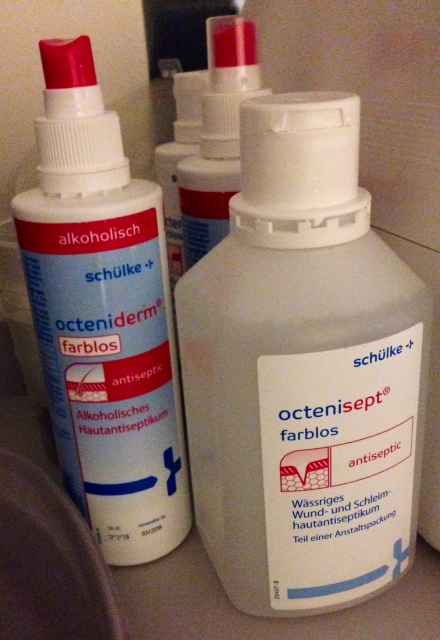
Small things can make a huge difference and are an indication of the underlying value system.
discovered another one of these small differences in Pádraig’s room: several bottles containing liquids to clean out his mouth. They don’t cost much, but weren’t available in Beaumont; one example of care that was not available to long-term patients with ABI. In Beaumont, we were told several times by consultants that there was nothing that could be done for Pádraig – except to wait for his brain functions to improve. But, do patients loose their right to their physical integrity and dignity just because their brain functions are not as they should be? Is it ok to neglect patients and their bodies, until their brain functions recover? Is it really a waste of resources to do all that is required to care for patients, no matter whether their brain functions? Is it ok to accept physical damage like dropped feet, dislocated shoulders, and bed sores, never mind potentially broken or damaged teeth, an infected mouth, and other damage as not-so-important secondary, collateral damage – until the patients recover meaningful brain functions? What kind of value system does a society have that allows this to happen? Care (or rather: lack of care) for brain-damaged patients has a long and ‘difficult’ history, not least in Germany. That this difficult history is still throwing shadows into the presence in relation to the kind and level of care provided, at least the care that we experienced in Ireland (personally and provided to others), needs to be addressed and changed.
We visited my 90-year old mother today, and an 88-year old relative of my wider German family. They light candles, pray, and are full of hope for Pádraig. They have lived for too long to believe in the ‘real world’, they do believe in a reality beyond that of percentages, figures, or metrics. They escaped death more than once in their lives. And they are a tremendous example of how to be brave and remain full of hope in the face of some of the most difficult and horrible things that life can throw at you. This morning, I decided to learn from them.
Today’s German Music Tip
Novalis, Wer Schmetterlinge lachen hört (1973). Check out the lyrics here. The group took the name from the German romantic poet Novalis (1772-1801) and became famous in the mid 1970s in Germany – and very little beyond. They were a little like the German Pink Floyd. “Wer Schmetterlinge lachen hört” and “Sommerabend” were their most famous songs. I was one of their most devoted fans for two or three years, leading up to my Abitur (leaving cert).
What’s hot
Days getting longer
What’s cold
Being a victim
The German word/phrase/verse of the day
Der weiß, dass er nichts weiß, wie alle anderen auch nichts wissen. Nur weiß er, was die andern und auch er selbst noch lernen müssen. (Novalis)
Twitter: @forPadraig
#caringforPadraig
web: http://www.caringforPadraig.org
 Hospi-Tales
Ah, Reinhard, I am dying to see him! So beautiful asleep, well-nigh oblivious of my presence, but with the contentment of dreams on his face. Life is one third dreams anyway, one third hopes, one third duty.. What have I been drunk on? Sufi poetry and Catholic prayer and saints! ..ever since the accident. I leave to Science respectfully what Science can do (at its best) and pray and love for the rest as well.. I even pray for Science and was answered with it, thank God! But I also pray for Hope, and for all that Hope itself prays for.. Hope Eternal.. Meanwhile we wait in patient love and Hope, hope, hope.. loving him. well nigh drunk on it! drunk with hope. hick.. and love, eternally.
May be a lot of us are paying to much attention to the third of duty, Joe. Food for thought. And black coffee!
Hello again, Reinhard. I have been thinking about your mother and your other elderly relative and of their steadfastness. And this word I’ve just used – ‘steadfastness’. Not one we tend to use much, but I seem to recall having used it in a previous post, and it does seem to describe a quality greatly needed in the present circumstances, however much one might wish otherwise. I had coffees and lunch with various people yesterday, and they all wish the very best for Pádraig, of course, even though they are all strangers to him. It is not uncommon for an enquiry about Pádraig to be the very first topic of conversation when I meet a friend or acquaintance. He truly touches people’s hearts. It won’t be long now – just under three weeks – till I get to see him again. Ì’m warming up my Irish in preparation – in fact, my schoolfriends and I, at lunch yesterday, noted our varying levels of Irish and of commitment to speaking it. We were lucky enough to have the benefit of an Irish-language education. We should be more mindful of this than we actually are. In this regard, Pádraig and his friends are examples to us. All the best, Louise.
Steadfastness – it’s far to old-fashioned, Louise. At a time when stuff is bought to be thrown out within weeks, and politics is made by opinion poll, steadfastness seems to be so yesterday. But then, if you keep your clothes long enough, they will become fashionable again. The same has to be true for values. I am with you on this one. Reinhard
Really powerful words that should go further than this blog. It’s simply unacceptable that Pádraig has been forced to emigrate because his own nation cannot grant him his basic human rights. I don’t say this lightly, it would make you shameful to be Irish. Since this recession hit it really exposes how lacking we are in the republican values we claims to have. God bless you all and may 2014 bring Pádraig back to full health.
Ailbhe, although I am not Irish legally, I feel like an honorary Irishman, and have lived more than half of my life and almost all of my working life in Ireland. Friends have introduced me as Reinhard O’Schäler. I think that there is a huge difference between the culture, in the widest sense of the word, of the Irish people and that of the people ruling Ireland, who seem to perceive Ireland as their boutique-like-country. They keep talking about the ‘real world’ but have not the faintest idea of that reality. Emigration is not, as Michael Noonan said not so long ago, a life-style choice – at least not for people in Pádraig’s situation. It’s forced upon them, and their families. Even if it breaks their heart in their already battered bodies. – And it’s not a question of budget, I think, but a question of priorities. What do we most care about? What are the most important values we believe in, and are ready to stand up for?
I’d be proud to be Irish, but be ashamed to be one of those in power (political, financial, …).
Reinhard