Major Tom

131127 Road at night

Going home in the evening on dark roads is a long and drawn out journey.

The experts were discussing on RTÉ who, in their opinion, was the best singer and what the quality was that made them the best. Most of the experts agreed that it was ‘authenticity’ that mattered most. They said, you really need to feel that the music is at one with the person who performs it. But then, there was this one critic who said that this was absolutely and completely wrong: one of the best singers, musicians, and performers of the world, David Bowie, was at his very best when he was not himself at all, but slipped into the persona of Major Tom, völlig losgelöst von der Erde.

Today, I decided to learn about Beaumont Hospital in Dublin, where Pádraig spent almost four months up to 11 November. The information I found differs slightly. The ‘About’ page on Beaumont’s own website (www.beaumont.ie) says it employs approximately 3,000 staff and has 820 beds. The HSE’s site (http://www.hse.ie/eng/services/list/5/nccp/about/Beaumont_Hospital.html) says it employs approximately 3,500 staff, catering for a local community of 250,000 (HSE) versus 290,000 (Beaumont), in addition for it being the “designated Centre of Excellence in Cancer Services and … the Regional Treatment Centre for Ear, Nose and Throat, and Gastroenterology. (It also is) the National Referral Centre for Neurosurgery and Neurology, Renal Transplantation and Cochlear Implantation.” Compare this with the Schön-Klinik in Hamburg: they employ 1,500 staff, covering 700 beds. In terms of patient/bed to staff ratio, Beaumont employs almost twice the number of people than the Schön-Klinik.

It is hard to understand how this is possible – because one of the first things you’d notice about the ward where Pádraig is, is the (generally) much more relaxed way staff works and deals with their patients. The clinic has a long history, and Alfons Maria Jacob described here for the first time in 1920 the Creutzfeldt-Jacob decease. Beaumont is much younger. Again according to Wikipedia, it was planned and commissioned from 1978 to 1984 and represented an investment of IR£50 million. It opened on November 29, 1987 following the closure of two smaller and older Dublin hospitals: The Charitable Infirmary, better known as Jervis Street Hospital and St. Lawrence’s Hospital (known as The Richmond).[2

Pádraig sat out in his ‘chair’ for many hours today. You can see how that makes him tired. His heart rate goes up, as does the frequency of his breathing. They had washed his hair again today, not sure how they are doing it, but they do it! Again, he has been reacting to our voices and touches. Overall, sitting up is really good for him: it keeps the blood pressure going, helps him clearing his lungs, etc. Today, two of his Irish friends had to go back home today. They were great company for Pádraig, and it was brilliant that they could make it. They were the first of quite a respectable number of his friends coming over for a visit, making sure that the connections are kept strong and kicking.

David Bowie’s and Peter Schilling’s Major Toms both decided to go floating into the outer space. They were the creation of a time when everything was possible – even space exploration.

“Here am I sitting in a tin can
Far above the Moon
Planet Earth is blue
And there’s nothing I can do.”

Major Tom was happy: life was amazing and full of wonders. Bowie showed us that there is a bit of Major Tom in all of us.

Today’s German Music Tip
Peter Schilling, Major Tom (1983) (This is a recording from the German version of Top of the Pops, called Hitparade. Watch the head move, and just one blink from Peter during the whole song!)
What’s hot
No driving tonight.
What’s cold
Tonight’s news about the CRC top ups.
The German word/phrase/verse of the day
Völlig losgelöst von der Erde

13,219,200

One second can change it all. Whatever life you were used to, whatever innocent dreams you had. — Today, it’s exactly 5 months, or 21 weeks and 6 days, or 153 days, or 3,672 hours, or 220,320 minutes, or 13,219,200 seconds that a 4.3-ton van hit Pádraig at around 10am on Rt. 6A in Brewster, MA. Doctors did not think he would survive. He did. He is still recovering and not fully awake yet. But he clearly has communicated with the people around him, still in a basic kind of way, but nonetheless he has communicated.

One second can change it all. When the world is your oyster there are only opportunities, stuff to be tried out, adventures to be had, people to be with, countries to visit, talks and discussions, fun and dance all night long.

One second can change it all. What is important to you now, what was important to you before. How everything is different from one moment to the next. When life past seems so innocent, and full of happiness.

One second can change it all. We are waiting, hoping, and praying for this second, this second in the future when happiness will be with us once again.

We have time.

131127 Conradh 180px-Conradh_na_Gaeilge_Baile_Átha_Cliath_2006_Kaihsu_Tai

Conradh na Gaeilge, Harcourt Street, Dublin

Today, Pádraig spent almost 2 hours in the morning and about 4 1/2 hours in the   evening off the assisted breathing / ventilator and on what the Germans call ‘Feuchte Nase’, i.e. what he had been on for a few months in Beaumont – only at only 2l of oxygen instead of the 4-5l from Beaumont. For the first time in a long time, his temperature was just above 37, heart at 80, oxygenation at 98 – all pretty normal. The two friends on a visit from Ireland might have reassured him that all is well. It is so good of them to have made the long journey from Dublin to Hamburg, to spend some time with Pádraig. Tonight, he opened both of his eyes and was quite responsive. We are planning to have a meeting with an Oberarzt to find out about what they are planning, and how they see Pádraig’s progress, for early next week.

Some of Pádraig’s friends are organizing a night for Pádraig in Conradh na Gaeilge, Harcourt Street, Dublin, on Friday, 06 December, 07:30. Check it out.

Today’s German Music Tip
Hannes Wader, Heute hier morgen dort (1982) (my favourite German folk song – there is a mixed German/English version available too)
Heute hier, morgen dort,
bin kaum da, muss ich fort,
hab’ mich niemals deswegen beklagt.
What’s hot
Keep going.
What’s cold
Being stuck with no way out.
The German word/phrase/verse of the day
Staplerservice (as seen on a German truck offering fork-lift services)

Imagine – and no religion too

Pádraig’s is the only room with a mass card and a little bottle of water from Lourdes, one of our friends sent for him. Hamburg is, like the rest of northern Germany, predominantly protestant. At the beginning of the last century, Max Weber wrote a famous book called “Prostestant Ethics and the Spirit of Capitalism” (Die protestantische Ethik und der Geist des Kapilalismus), in which he discusses the connection between protestant ethics and the development of capitalism in Europe. The desire to achieve things.

Pádraig was sitting in a ‘chair’ when I came in to visit him today. It’s like a cross between a really comfortable arm chair and a bed. He look super-comfortable and spent more than three hours in this chair today – there is nothing better for his lungs than sitting up, at the moment. Two carers had slipped him across from his bed into this ‘convertible’ chair by pulling him across from his bed onto this chair/bed. They could do this with two people. In order to move him from his bed into a wheel chat, they would have needed 3 people.

When I told them that carers and nurses in Ireland had used a hoist to lift him out, I was told that they would not use a hoist here for someone like Pádraig, that this wouldn’t be safe enough. Later in the day, I talked to the Oberärztin looking after Pádraig. She said that on Friday they would try to turn him completely onto his chest in the bed, in order to clean out his lungs from any secretions.

Christmas Tree in Tating!

Christmas Tree in Tating!

Two of his best friends from Dublin arrived today. It has been so nice to see them, and, although Pádraig wasn’t at his most alert today, I am sure he was so happy to hear familiar voices, and especially Irish. They will stay until Thursday – it’ll be really nice to have them around. And it was so good for them to make the journey over to Hamburg to visit Pádraig.

Pat once told me that the nuns running her school wanted to be up-to-date and modern  and all, and sang all sorts of great contemporary songs with them. One of their favourites was John Lennon’s ‘Imagine‘: “Imagine there is no country, it isn’t hard to do. Nothing to kill or die for, and no religion too… You may say I am dreamer, but I’m not the only one…” According to Pat, with all their enthusiasm, it took the nuns a long time to notice the bit about “and no religion too”. – Myself, I hear and see Alice’s Restaurant in the last line: I might be a dreamer, but I’m not the only one.

I believe that our dreams can inspire others. The desire to help other people because this is the right thing to do is something that I found in Dublin more than anywhere else. The amount of help, love, and support Pádraig is receiving from his wider family and friends is inspiring, and nothing I have ever experienced previously in my live. – I wonder, is there the possibility of a connection between catholic Ireland and German protestant work ethic? Just Imagine.

Today’s German Music Tip
The Beatles, Sie liebt Dich (1964) (The Beatles startet their career on 17 August 1960 in the (in)famous club Indra, just off the Reeperbahn.)
What’s hot
Imagine.
What’s cold
Being stuck with no way out.
The German word/phrase/verse of the day
Ja, sie liebt Dich und da solltest Du Dich freuen!

Turkeys voting for Christmas (or Thanksgiving)

One of our friends on the Cape reminded me that Thanksgiving is coming up soon, in fact it’ll be Thanksgiving this coming Thursday, November 28th. I had to think of turkeys, immediately. And of Alice Glenn. I emailed the story of Alice Glenn to our friend (who remembers Alice Glenn?:) who famously said during the debate about the divorce referendum here in Ireland that “women voting for divorce is like turkeys voting for Christmas” – or Thanksgiving in the US. I could see our friend smiling in my mind when she read this…

Thanksgiving also remembers me of a song, in fact it is the longest folk song ever recorded, which also was made into a movie.  The story of “Alice’s Restaurant” (no – not Alice Glenn’s) by Arlo Guthrie (Woody’s son), even older than Ireland’s divorce referendum, originated on Thanksgiving, 1965, at the time of the Vietnam war, when young kids in the US were drafted to fight for freedom and democracy, and many (amongst them, Arlo) found a way out – sometimes in quite unexpected ways. (The original song was recorded in 1967, but Arlo kept singing and recorded another live version in 2005 at the Guthrie Center; you can find the lyrics here.)

The bit I like most is when Arlo tells his listeners that they should join the Alice’s Restaurant movement:

“… and walk out. You know, if
One person, just one person does it they may think he’s really sick and
They won’t take him. And if two people, two people do it, in harmony,
They may think they’re both faggots and they won’t take either of them.
And if three people do it, three, can you imagine, three people walking in
Singin a bar of Alice’s Restaurant and walking out. They may think it’s an
Organization. And can you, can you imagine fifty people a day, I said
Fifty people a day walking in singin a bar of Alice’s Restaurant and
Walking out. And friends they may thinks it’s a movement.
And that’s what it is , the Alice’s Restaurant Anti-Massacre Movement.”

Sometimes you just have to walk out, others will follow, and you might start a movement.

Another friend asked how the Irish and the German health systems compare, generally. 131125 350px-Total_health_expenditure_as_a_Percentage_of_GDP_(2005-2008)Whether I thought that the difference between our experience in Germany and in Ireland originates in cultural differences between the two countries or because of the different levels of funding available. I think it is both: Germans spent more on their health system (10.6% GDP) than the Irish (8.2%). In 2014, 666m euro will be taken out of the health system (some experts say that the total cuts will be closer to 1 billion), and deal a final blow to a system that is already at braking point.

When the CEO’s of the four major hospitals wrote a letter to the director general of the HSE in early November, saying that health cuts are beginning to seriously threaten patient safety (“There is clear evidence that funding reductions coupled with accelerating demand have begun to seriously threaten the quality and safety of patient services.”), the Minister’s response was that he could not comment since the letter was not addressed to him.

People working in Irish hospitals are conditioned by the realities of their work place. Many think that the care and treatment provided to the patients is adequate. As someone who spent close to 4 months in an Irish hospital with Pádraig, I would not blame the people, but the ‘authorities’ who do not guarantee resources, provide control, and implement sanctions where necessary. – Remember the headlines when staff was found not to wash their hands properly? How could it ever have come to that point?

Today, I spoke to the man in charge of the intensive care unit where Pádraig is being looked after at the moment, the ‘Chefarzt’. What struck me was how positive he was about Pádraig’s progress and his very positive outlook. I had stopped him on the corridor (this might ring a bell with friends who are familiar with a similar situation we went through in Ireland), when he was completely unprepared – nonetheless, he showed that he was familiar with Pádraig’s case, he commented on some quite specific questions I asked, and he demonstrated that his doctors have a definite plan for working with Pádraig on improving his situation. It was refreshing, and evidence of a level of attention a patient like Pádraig would, obviously, never get in an acute neuro-surgical ward, such as the one he spent 4 months in, in Beaumont.

The Schön-Klinik in Hamburg is one of Germany’s leading hospitals for neuro-rehab and was, historically, the second hospital in the country where early dedicated and intensive neuro rehab was offered to patients. The Chefarzt in charge of Pádraig is heading up a neurological Intensive Care Unit with 40 beds; there are 49 beds for early neuro-rehab. And listen to this: there are a total of 200 carers/nurses, 45 doctors, 12 consultants, and 72 therapists. – The whole of Ireland has 3(!) beds for early neuro rehab, with a waiting time of one year(!).

Pádraig has been doing well, given the circumstances. He opens his eyes more often then before, his breathing, heart beat, and temperature are all closer to normal than during the previous days – and I am sure that he is very much looking forward to the first visits by his friends starting tomorrow!

Going back to Thanksgiving, Alice Glenn, turkeys, and Alice’s Restaurant. If the turkeys decided to walk out first in pairs, then 3 at a time, and eventually in groups of 50 – they could become a movement – and if we all said “enough is enough”, our movement would impact change. Forget about 12 months – 24 (hours), no more!

Today’s German Music Tip
Spliff, Carbonara (1982)
What’s hot
Caring.
What’s cold
Just everyone for themselves.
The German word/phrase/verse of the day
Scusi Segnorina, willst du auch’n Spliff, oder stehst du nur auf Männer mit Schlips?

Ich bin Ich

Leaving Hamburg in the evening leads us across the Kennedy-Brücke. Since last Friday

Drive Time

Drive Time

was the 50th anniversary of JFK’s assassination, we talked a bit about what he meant and how much he moved in his time. Hyannis was and still is his family’s favourite place to spend the summer. Hyannis, of course, is also where Pádraig was operated on and where we spent the first weeks after his accident. i never did, but Pat and her friends actually saw JFK driving down Dorset Street in Dublin – where his car stopped to allow him to give a present to one of Pat’s friends. – Yes, we are getting old.

There are dozens of famous JFK quotes around. From being a ‘Berliner’ to doing work for your country. Here is one that made me think today: “Change is the law of life. And those who look only to the past or present are certain to miss the future.” I promised myself that we will make sure not to miss the future.

The care for Pádraig here continues to impress us. There is a dedication and care, a professionalism and personal touch that is truly amazing – and something to aspire to.

There was a piece on the Irish news over the past days reporting that there is going to be a significant shortage of GPs in Ireland and that young doctors are leaving the country. I wonder whether that made alarm bells go off in the Department of Health? How will the health service function, following a cut of 666m in 2014 which will in reality most likely rise to one billion, according to The Irish Times. Already, the health system is not functioning as well as it should. Many people in it are disillusioned, tired, and overworked. Where in the western world have you ever seen doctors in gowns wearing multiple buttons ‘shouting’ 24-no-more at their patients? People in Ireland not only deserve better, they need it to be better. It should not be acceptable that doctors have to leave the country, and the patients with them, out of sheer desperation.

I set up a Google Calendar for friends visiting Pádraig in Hamburg:
https://www.google.com/calendar/embed?src=ejbikhh20hgf5i87d88fenj9ns%40group.calendar.google.com&ctz=Europe/Dublin
Y
ou should be able to see the dates, and edit them – let me know how that works.

Today’s German Music Tip
Rosenstolz, Ich bin ich (2006)
What’s hot
Working on a computer and the internet while being driven to the hospital.
What’s cold
Getting out of the car being so dizzy that my stomach is just waiting for an excuse to bring back breakfast.
The German word/phrase/verse of the day
Ich bin Ich

When Time Disappears

Have you ever got obsessed with something? Anything? We acquired a new obsession. – When we drive home from the hospital in the evening, we are passing close to a dozen petrol stations. During the past week, we started to check out the price of petrol at each of these stations. It is absolutely incredible to see how petrol prices fluctuate. We have seen prices for E10 petrol between 140 and 149 cents, at the same station, on the one day. These 9 cent means, we figured out, a difference of almost 50 euro per months, on the basis that we drive 300 kmh/day on about 6l of petrol. – We have become obsessed with the price of petrol.

We also have loads of time to talk during these long drives. Today we commented on the fact that sometimes it is hard to see that Pádraig is making progress. Then, days merge into each other and timelines vanish: where we are, how got there, what the future hold. On the way back, at exactly 120 km/h to safe petrol, we got into this mood and while we were talking, we realized that some of the progress Pádraig is making becomes part of this time warp we have been living in for the past months. It was only when we were talking to we realized how much more relaxed Pádraig is now, the sudden, uncontrolled movements have disappeared over time, and he has become much more himself again. Still in a coma, but communicating and reacting in his own way.

This afternoon, Pádraig had a visit from his German family and his room got a bit crowded. A male nurse came in, looked at us in horror and asked what we were all doing in there. They had, in their generosity, allowed three people in at a time – now we were five. I assume he was right, but there is enough room , we were not in the way, and we all had traveled a long way to see Pádraig. So we left for a break, and when we came back we found Pádraig positioned in his bed by a true artist. What the nurse had done was done with such care and attention to detail, it was hard to believe. We made friends again:), and thanked him for taking such good care of Pádraig. He said that this was the reason he had chosen his profession, he wanted to care for people. He had brushed Pádraig’s teeth with a soft tooth brush, and his cheeks and tongue with a special suction swab. His lips and face were covered in soothing cream.

Today’s German Music Tip
Die Ärzte, Rebell (1998)
The German word/phrase/verse of the day
Straßenunterhaltung (“Street Maintenance” or “Street Entertainment” – take your pick:) – seen on a Hamburg City Council truck.

No Country for Sick Men

In 1986, when a lot of you weren’t even born, I moved to Ireland. It was a dream come true. I had listened to Clannad in Dortmund’s bunker (a folk bar in a WWII bunker) in 1976. They arrived 3 hours late because they had been stopped on the Autobahn by German police looking for terrorists – they had, after all, very long hair. In 1997, I walked up the west coast with a friend and we both thought that to live here would be heaven. When Pat and I moved to Dublin, it was like a dream come true, the beginning of a new life, and a new family. I never thought that we would have to leave one day.

131120 frost

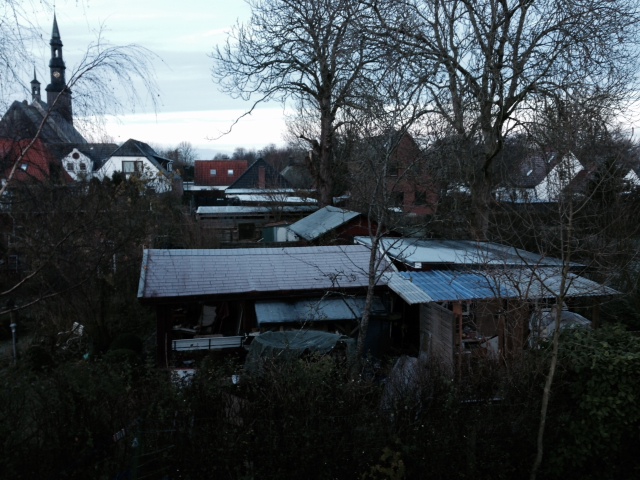
First frost on the roofs in Tating

This morning, we got a phone call from the hospital. The doctor who rang us made the mistake not to introduce what he had to say by “no need to worry, everything is alright” – so we had a few anxious moments until he told us that he was ringing to ask us for permission to take out some of the cerebrospinal fluid from Pádraig in an attempt to reduce pressure from Pádraig’s brain. Apparently, it’s a routine procedure, there is a bit more involved than drawing blood, but not much, he said. The only risks would be infection and possible bleeding, but they were minimal and would be kept well under control. We would see in a day or two if the procedure would have any positive effect on Pádraig’s level of awakeness. We consented, of course, and the procedure was carried out this morning. We’ll have to wait and see whether it’ll make a difference.

When we went to visit Pádraig later in the day, he was still on the ventilator, with a bit of a fever. The doctors explained that they were looking for bacteria that caused the fever. We said that  both in Beaumont and in the US, doctors had been trying this unsuccessfully, and that the slight occasional fever might not be caused by bacteria or an infection at all. We also agreed with them to start a special treatment for his lungs with the physios on Monday, to clear the phlegm out of his lungs on a regular basis.

There will be a steady flow of visitors from tomorrow. I am sure, Pádraig will be delighted to have his friends around again. He must be missing you, your voices, your stories, your presence.

Finance Minister Michael Noonan said in January of this year that young emigrants are not driven away by unemployment. Instead, he said, emigration in most young people’s cases is being driven by “a desire to see another part of the world and live there” (as reported by TheJournal in January 2013). Sarah Stack, on 27 September 2012, reported in the Irish Independent that, according to official figures published by the Central Statistics Office (CSO), 87,000 people emigrated from Ireland in 2012, a new record.

I don’t know whether Michael Noonan is right or not, but I know that at least Pádraig did not get the treatment he needed when he needed it. Being told that he would have to wait for the best part of a year for a bed that he needed straight away basically forced him out of the country. He was emigrated. It was not a life-style choice. I don’t know anyone who loves Ireland as Pádraig does.

Today’s German Music Tip
Marius Müller-Westernhagen, Wieder hier (1998) (Westernhagen is the ‘raw’ version of Lindenberg, although this song is almost too sweet for him.)
What’s hot
Pat driving the red Kia Ferrari to Hamburg, and back
Me sitting in the passenger seat looking at the scenery
Kilometres we have driven to-date (since Wed., 13 Nov): 2,356
What’s cold
Surprise calls from the hospital
Isolation, isolation
Having dinner at 10pm
The German word/phrase/verse of the day
Ich bin wieder hier
in meinem Revier
war nie wirklich weg
hab mich nur versteckt
ich rieche den Dreck
ich atme tief ein
und dann bin ich mir sicher
wieder zu hause zu sein
(Westernhagen, Wieder hier)

Trapped

Tags

,

Cairde a chara

Last night, I collected Pat from the train station in Heide (yes, this is the city with Germany’s largest market square!). You’ll remember that we gave the little red Kia

Trapped and ready to ring 110

Trapped and ready to ring 110

Ferrari a break, as Pat went straight from the airport to see Pádraig and then took the train towards Dithmarschen. For a change, I was on time. And waited. Until Pat rang and asked me where I was. Turned out we were on opposite sides of the quite small railway station, me in the car and Pat – trapped in the Deutsche Bahn waiting room, having escaped from the arctic temperatures outside. When my engineering skills failed to open the automatic door, Pat and I decided we were not going to smash the glass but to ring 110 instead (that is 911 for the Americans amongst you). 10 minutes later, security arrived and opened the door. When we pointed out that this was something quite dangerous: a door that allows people in but then leaves them with no way out, the security man said: “Well, she shouldn’t have gone in there in the first place”. Right, we thought. In our innocent minds, we had expected an apology but now were getting a whole new perspective on things. You might find that doors open on the way in but are firmly shut close when you are trying to get out.

Today, Pádraig took a small step back. The microbiologists discovered traces of a bacteria or germ which required Pádraig to get back into isolation, and us to get back into our beloved blue gowns and mouth protectors. There is no clinical evidence of the bacteria, i.e., they don’t do any active damage at the moment, but the hospital is über-careful to contain any possible threats. It was easy for Pádraig to get into his bright new high-tech room – I hope we won’t have to call Deutsche Bahn security to get him back out, one day soon.

We are trying to tell the nurses and doctors what Pádraig can and what he cannot do, what he needs and what he doesn’t need. They haven’t figured out yet how Irish families work and still live under the illusion that they could fob us off telling us ‘stories’ when we represent a collective year of ICU experience by now. For example, there is no-one better than Pat to know when Pádraig needs to be suctioned, the nurse who didn’t believe this learned about it tonight. We give them another week or so, by then everybody will know much better where they stand.

This morning, we heard on RTE that the European Commission is bringing Ireland to the  European Court of Justice because it failed to implement the European Directive of the 48-hour-per-week maximum working time. The EC felt that this was not just unfair to doctors but that the practice was also putting patients at risk. Apparently, Minister O’Reilly, himself a doctor, didn’t understand what the fuss was all about as he had already clarified that the 2003/88/EC directive would be implemented in late 2014 – just 11 (eleven) years after it was published. – You wonder whether O’Reilly is capable of getting out of the trap of his protected life as a minister. Should we ring 110?

Le meas,
Reinhard

Today’s German Music Tip
Udo Lindenberg, Highlights of MTV Unplugged (2011) (Don’t be mislead by the ‘2011’, Udo is Germany’s oldest and original Rock Musiker who teamed up with some younger German colleagues to play some of his best music in the Hotel Atlantic in Hamburg just two years ago. I know all the lyrics off by heart:)
What’s hot
The no-Stau Autobahn
<6l/100km
LTE
Kilometres we have driven to-date (since Wed., 13 Nov): 2,074
What’s cold
Isolation
The weather
The German word/phrase of the day
Die wolln mir erzählen von Hamburg bis Laos, wo’s hier langgeht in diesem Chaos. (Udo Lindenberg in: Der König von Scheissegalien)

Verdamp lang her

Wolfgang Niedecken’s song tells one of these father-son stories: It’s been a while (Verdammt lange her, or in the dialect of Cologne: Verdamp lang her), he sings, since we really talked, and that what we said got actually through to the other. I am sure many people have felt like this. We always (but wrongly) think that we’ve got all the time of the world to have this important talk with those close to us, when we’d say all those important, maybe somewhat ‘deep’ things we always wanted to say but never did. German’s are actually really good at looking deep into the inside, and talk about it nonstop (… I am writing this blog, after all:), whereas the Irish communicate more indirectly and the ‘big’ things when they happen can easily be missed if you don’t pay attention. Think Philadelphia here I come.

Today, I did not drive. I cannot believe it! My whole body actually feels like as if it had been transformed into this shape that perfectly blends in with the driver’s seat of the Kia Pactera, our perfect wheels hitting the German Autobahns at a carefully balanced 120km/h. So if I sit at a desk, like today, my body just cannot cope anymore with all the empty space surrounding it. (You need to have been in a Pactera to appreciate this. I had never heard of this car until about two weeks ago. Look it up and you know what I mean.)

I did not drive because Pat went straight from the airport to the hospital when she arrived this afternoon. She is getting the Nordostseebahn from Hamburg to Heide where I will collect her in about an hour. The just 30 minute-drive will be a poor compensation to the usual close-to-four-hours we usually get – sometimes, a little is better than nothing:)

131120Ihre Meinung

Ihre Meinung ist uns wichtig!

Pat just sent a message from the train saying that Pádraig is out of isolation! No more blue gowns and face masks! It’ll be a whole new visiting experience for all, and it’ll be much easier for Pádraig to actually recognize who is visiting him! And this is not all: he is also off the antibiotics! One day I’m not there and all these good things start to happen… Pat told me that one of Pádraig’s good friends called today and talked to him over the mobile (God bless Meteor for free roaming). She said it looked like as if there was a great conversation going on – and we are all sure that there will be, once he’ll have got rid of the tracheostomy that prevents any ‘sound production’.

A good day.

So here is the first, and my favorite verse of the song I mentioned earlier, in Kölsch (the dialect of Cologne, for those advanced German speakers amongst you), in German (for those interested in it), and in English (as a backup).

Verdamp lang her, dat ich fast alles ähnz nohm.
Verdamp lang her, dat ich ahn jet jejläuv
un dann dä Schock, wie et anders op mich zokohm,
merkwürdich, wo su manche Haas langläuf.
Nit resigniert, nur reichlich desillusioniert.
E bessje jet hann ich kapiert.

Verdammt lange her, daß ich fast alles ernst nahm.
Verdammt lange her, daß ich an etwas geglaubt.
Und dann der Schock, wie es anders auf mich zukam.
Merkwürdig, wo so mancher Hase langläuft.
Nicht resigniert, nur reichlich desillusioniert
– ein bißchen etwas habe ich kapiert.

It’s been a while, that I took almost everything serious. It’s been a while, that I believed. And then the shock, when things turn out quite differently – strange how roads turn sometimes. Not yet resigned, but pretty much disillusioned – I understand just a bit by now.
(The full translation of the lyrics can be found here.)

Below is a link to a wonderful live performance – I had forgotten what we looked like when we were Pádraig’s age:)

Today’s German Music Tip
BAP, Verdamp lang her (1981). (A really amazing life performance by Wolfgang Niedecken and his band, BAP. I lived in Cologne when they got big. It was an amazing time. – Another favourite from the same band with some unbeatable lyrics: Frau ich freu mich.)
What’s hot
Un-Isolation
Sitting at a desk (and not behind a Pactera’s steering wheel)
Kilometres we have driven to-date (since Wed., 13 Nov): 1,707 – not much of a change since yesterday!
What’s cold
Antibiotics
The German word/phrase of the day
Ihre Meinung ist uns wichtig (“Your opinion is important to us.” On a postbox in the hospital’s waiting room.)

Tanzfieber

Tags

Today Maria and I left early for Hamburg. The senior doctor in the Schön-Klinik had made a special arrangement for her to see Pádraig at 1pm, two hours prior to the start of the official visiting time at 3pm, as she had to leave for the airport at 2pm. (Yes, it is and doesn’t just sound complicated.) For the first 45 minutes, traffic was like every other day: pretty light. Once we hit the A23 motorway at Heide, we thought we were doing fine. There are two long road works on this motorway, with an expected completion date of summer 2015! We had just driven into the first road works when traffic stopped. Completely. A car had broken down, apparently, blocking the one lane available to traffic. When we got going again, we knew we had to go directly to the airport. We had to skip Maria’s visit to the hospital. I told Pádraig about the traffic jam, and that Maria would be back soon. I am sure he understood.

Some more small details that make a hospital stay different here: we were used to bring in Pádraig’s own mouth cleaning ‘sticks’ (we bought them in our local pharmacy, and

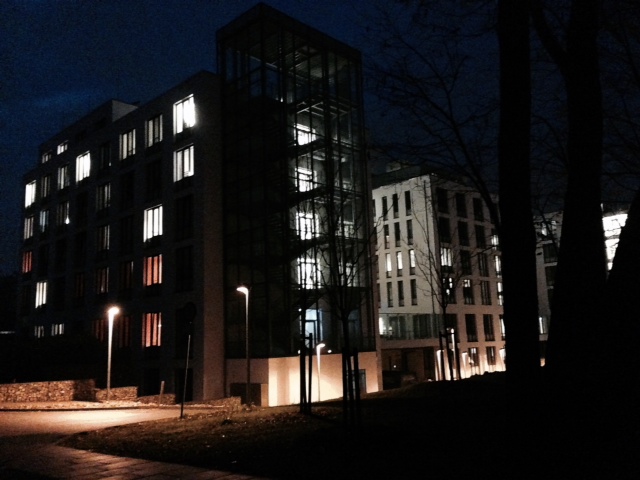
It gets very dark very early in Hamburg - the Schön-Klinik in the afternoon.

It gets very dark very early in Hamburg – the Schön-Klinik in the afternoon.

the nurses told us they were brilliant); deodorant (remember: 6 very sick people in one relatively small room, not always well aired?); cream to keep his skin in good condition; and other sundry ‘stuff’. Here, they have their own mouth hygiene sets in the hospital (even with little ‘hovers’ attached to prevent liquids going down the throat); there are no aerosol sprays and there is not need to cover up bad odours (there are none); and they have sets of different creams for his lips and his skin. In the Irish hospital, the tube  carrying oxygen and going into his throat was protected by a blue-coloured open half-moon-shape-like semi-cover; here the tube is closed and covered by an air filter: dust and bacteria would have a hard time getting into his lungs through that filter. The senior doctor consulted with the hospital’s dentist to organize a tooth guard as he is still grinding his teeth at times. (This was looked at previously as just another potential ‘collateral’ damage that could be dealt with later.)

To keep Pádraig in touch with Ireland, I play (Irish) music to him – I am under strict instructions not to play my music. (What is wrong with my music?) So I played music from a CD a very good friend had brought in some months ago: Bí Ann by Kila, Tír na nÓg, A-Team, Hall of Fame,… by the time we reached Mexico (as Gaeilge) by Mundi he was sweating, his heart rate was up, …and something or someone had moved the gadget on his finger measuring his oxygen saturation – which made several alarm bells go off all over the place: the system thought Pádraig’s oxygen had suddenly gone down from 96% (normal) to less than 80% (not good). The nurse came running into his room in a panic – by which time I had corrected the ‘error’ (and switched off the music). She took it quite well, I thought, and checked his other markers, since she was there now anyway. When she said that she didn’t like his temperature (just over 35o), I confessed that we had been listening to some music, and that I thought it had been the music that had brought up his heart beat and also probably his temperature: She looked at us, smiled, and said: must be ‘Tanzfieber’ then.

What’s hot
German music tip: Herbert Grönemeyer, Männer (1984) [He of Wolfgang Petersen’s movie Das Boot. A bit like a response to Ina Deter:)].
The coffee offered today by Pádraig’s student nurse.
Kilometres we have driven to-date (since Wed., 13 Nov): 1,647
What’s cold
Petrol prices – they ‘swing’ by 10 cent within one day.
Stacks of letters from the insurance company.
Traffic jams on the A23.
The German word of the day
Tanzfieber