
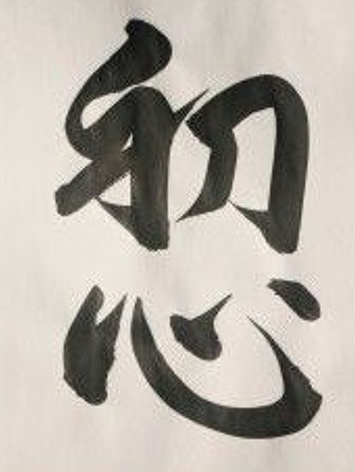
In the beginner’s mind there are many possibilities, but in the expert’s there are few.
Shunryu Suzuki, Zen Mind, Beginner’s Mind: Informal Talks on Zen Meditation and Practice
There are different ways to express this concept. I only came across Shoshin and the Beginner’s Mind recently.
The mother of an An Saol Centre client mentioned to us today in the Centre that she had left a tissue with Pádraig for him to clean his mouth as she didn’t want to touch his face. Didn’t seem to be a big deal to her. Because, that’s what we do, right? When we want to clean our mouth we get a tissue or a serviette and clean it.
Only that this is not something Pádraig had done before, since his accident. For us it was a huge deal when we saw that Pádraig was well able to grab the tissue and wipe his mouth. We tried it again at home later and realised, again, that he was able to do so much more than we had expected.
We put a tissue on top of his left hand. He turned it, grabbed the tissue and wiped his mouth.
Before this, we hadn’t given him the opportunity to do this, because we didn’t think he could do anything with the tissue.
Many perceived limitations of a person are, in reality, imposed by others, by pre-conceptions, and (lack of) expectations.
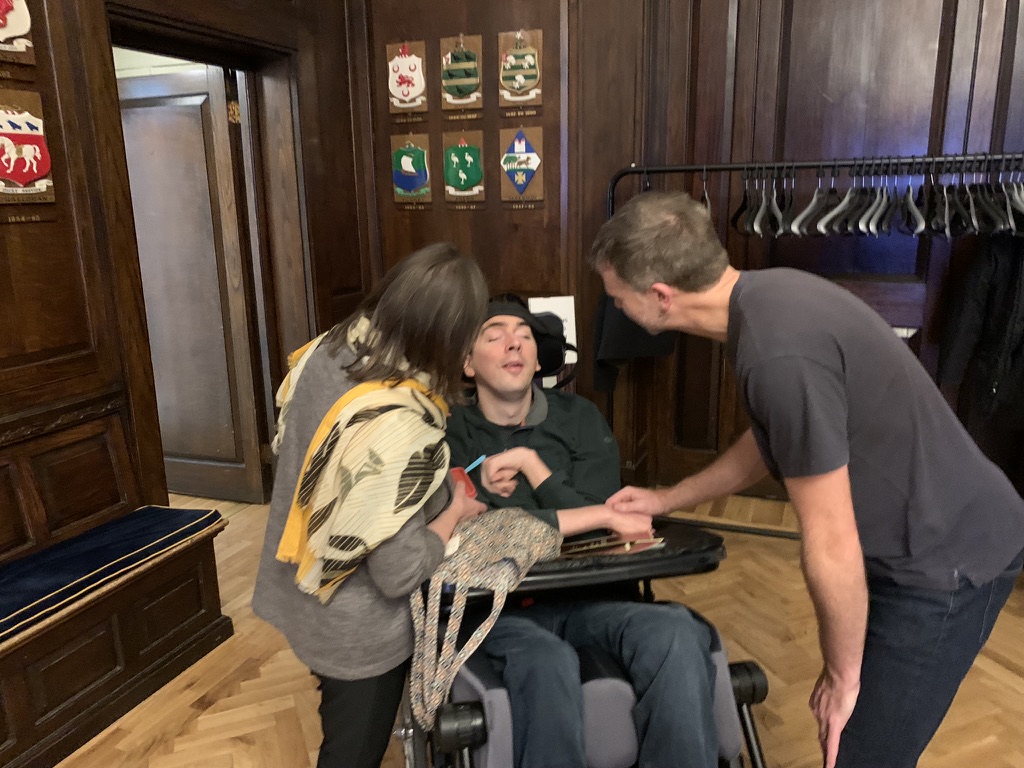
It was raining last night. Summer in Dublin. Pádraig went out to see one of his favourite bands, Bell X1, in the Iveagh Gardens. Danny from the Coronas and his mother, Mary Black, were sitting next to him. During a break, Mary Black came over to say ‘hello’. I was a great, memorable night.

Pádraig met Paul Noon, Bell X1’s lead singer, in December of last year, when Paul joined us at the An Saol Foundation’s Advent Fest.
Preconceptions, knowing what is going to happen, coming up with a diagnosis and prognosis – these are all things taught to clinicians.
One reference I found relates to a maxim coined by Dr Theodore Woodward in the 1940s: When you hear hoofbeats, think of horses, not zebras.
This is still taught as a “useful” reminder that clinicians should diagnose the common causes rather than search, at exorbitant length (and cost), for low probability causes.
I heard this expression during the long months we spent in hospitals, and many more times since, when what seems to be the most obvious prognosis is made and set in stone. Which sometime can be like a death sentence for the patient.
There other views, even in the medical world: Louise Younie wrote about the Beginner’s Mind in The London Journal of Primary Care (PubMed Central):
The concept of ‘beginner’s mind’ invites the expert medical professional to be present to their patients, remaining curious and responsive in the face of the individuality of illness. Each patient is a universe of unknowns, presenting with suffering which cannot always be classified with a diagnosis. Improvisation and openness may not just benefit our patients enduring their patient journeys but may also revive and reconnect us with our own humanity.
Like any professional, as GPs we are at risk of presumption and habitual thinking. Beginner’s mind, that is recapturing the openness and curiosity modelled to us by children, can powerfully transform the medical encounter, allowing space for emergence of patient perspective and doctor response.
Perhaps not surprisingly, the zebra is the official symbol of rare diseases in the United States.

Like rare diseases, severe acquired brain injuries aren’t rare. But they are, like rare diseases, difficult to diagnose. A firm prognosis is nearly impossible.
“Listen to the patient” because they have lived in their body longer than you have known them, and “Check your ego at the door” because patients and parents quickly become experts in their condition, should become mantras for all clinicians.
They should practice Shoshin (初心), Beginner’s Mind, a concept from Zen Buddhism which refers to having an attitude of openness, eagerness, and lack of preconceptions when studying, even at an advanced level, just as a beginner would.
It acts as a counter to the hubris and closed-mindedness often associated with thinking of oneself as an expert. This includes the Einstellung effect, where a person becomes so accustomed to a certain way of doing things that they do not consider or acknowledge new ideas or approaches.
Remember that, amateurs built the Ark, professionals built the Titanic, and never be afraid of to try something new.
Be cogniscient of the Dunning-Kruger effect.
There are a million opportunities. Even when the expert only sees one. Trust me.
 Hospi-Tales